 DomCop
In SEO, it’s often assumed that the older a domain is, the easier it is to rank. And while some argue that factors like click-through rates now matter more, an aged domain still brings real value to the table.
A URL that has spent years collecting a solid backlink portfolio and accumulating PageRank offers a foundation that a brand-new domain simply cannot match.
In this guide, we will break down how aged domains can improve SEO. From bypassing the Google Sandbox to inheriting high-quality backlinks, you will learn how to identify and use these digital assets to give your website a significant head start.
What Are Aged Domains?
A domain is the core of a website address. It is the digital identity that visitors use to find your site.
When you register a domain through a provider like GoDaddy, you are essentially leasing that name for a period of one to ten years. If an owner fails to renew the lease, the domain eventually expires and returns to the public market.
An aged domain is a URL that has been registered for a long time and has a history of activity. However, there is a distinction between two types of age that you need to understand:
- Registration Age: This refers to the date the domain was first bought. You can check this using a WHOIS lookup to see how long the name has existed.
- Index Age: This is the date search engines first found and listed the site. This is often more valuable for SEO because it shows how long Google has been aware of the domain’s content.
A domain might be ten years old but only indexed for two years if it sat empty for a long time. Practical tools like the Wayback Machine are helpful here because they let you see what the website looked like years ago. This helps you confirm if the domain was a legitimate business site or just a parked page.
Unlike a brand-new domain, a true aged domain carries a reputation and a history of previous use.
How Aged Domains Can Improve SEO
While Google representatives have stated that domain age is not a primary ranking factor, older domains often outperform newer ones.
This is typically due to correlation rather than a direct bonus for being old. In other words, it is not the birthday of the domain that matters, but what has been built on it over time.
The benefits can be categorized into direct impacts on your search visibility and indirect advantages that build long-term success.
Direct SEO Benefits
Direct benefits are those that provide an immediate, measurable advantage to your search engine rankings and site health from the moment you launch.
Established Backlink Profiles
This is perhaps the single most important direct benefit. High-quality backlinks are notoriously difficult and expensive to build from scratch.
An aged domain often comes with a pre-existing portfolio of links from authoritative sites. These links pass immediate link juice and PageRank to your site, giving you a massive head start that would otherwise take years to achieve.
Bypassing the Google Sandbox
It is a common observation among SEO experts that new domains undergo a probationary period, often called the “Sandbox.” During this period, Google limits its ranking potential while it assesses its trustworthiness.
Because an aged domain has already been indexed and vetted by Google’s algorithm for years, it can often skip this waiting period entirely and begin ranking for competitive keywords in a matter of weeks.
Faster Indexing and Higher Crawl Rates
Search engine bots prioritize domains they already know and trust. When you add new content to an aged domain, Google is likely to crawl and index it much faster than it would for a brand-new URL.
This means your new pages can appear in search results almost immediately, allowing you to react to trends or news in real-time.
Inherited PageRank
While Google no longer shares public PageRank scores, the internal metric still exists. An aged domain that has been active for years has likely built up a level of authority that acts as a multiplier for any new content you publish, making it significantly easier to compete in crowded niches.
Indirect SEO Impacts
While direct benefits provide immediate technical power, indirect benefits build the long-term sustainability and authority of your brand. These factors influence how both users and search engines perceive your site over time.
Topical Authority and Content History
When a domain has spent years focused on a specific subject, it builds what SEOs call topical authority. Search engines keep a record of the niche a domain belongs to.
If you buy an aged domain that was previously a photography blog and you continue to post about cameras, Google already recognizes the site as an expert source.
This historical relevance makes it much easier to rank for new, related keywords because the foundation of expertise is already laid.
Trust and Brand Credibility
Older domains carry a level of perceived legitimacy. For a user, seeing a domain that has existed since 2010 feels more trustworthy than one registered last month. This trust leads to higher click-through rates and better engagement.
These positive user signals (such as longer time spent on the page and more frequent return visits) indirectly tell search engines that your site is a high-quality resource, which can lead to higher rankings over time.
Domain Authority Growth
While metrics like Domain Authority (DA) or Trust Flow are third-party measurements, they are highly correlated with how Google views a site. These scores grow naturally as a site gets mentions and links over several years.
Starting with a domain that already has a “Respectable” authority score means you are not fighting an uphill battle. It provides a level of stability that helps protect your rankings during minor search engine updates.
Natural Brand Recognition
If the aged domain was previously a reputable business or a popular blog, it likely still has branded search volume. This means people may still be searching for the old brand name on Google.
By capturing this existing traffic and redirecting it to your new content, you benefit from a steady stream of highly relevant visitors who already have an affinity for the domain’s topic.
Where to Find and Evaluate Aged Domains
Finding an aged domain with a clean history and high authority is a strategic process. Because the market is competitive, relying on the right tools is essential to filter out the noise and find the diamonds in the rough.
Strategic Sourcing with DomCop
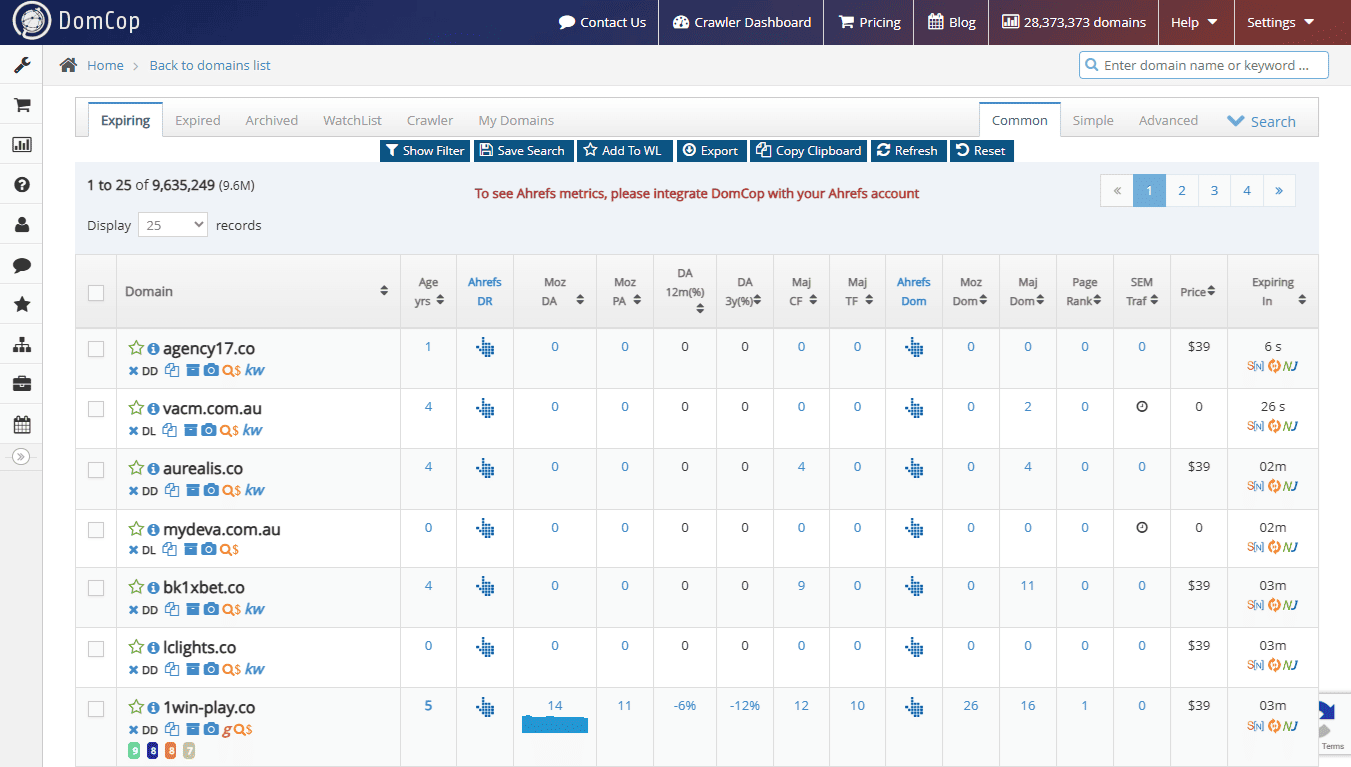
For many SEO professionals, DomCop is the primary choice for discovering aged domains. Its main advantage is the sheer volume of data it collects from multiple sources, including GoDaddy Auctions, NameJet, and various public drop lists.
- High-Level Metrics: DomCop pulls in over 90 different metrics for every domain, including Majestic Trust Flow, Moz Domain Authority, and SEMrush traffic data. This lets you quickly see a domain’s strength without manually checking each tool.
- The Guru Plan Advantage: One of the most powerful features for serious buyers is the Personal Crawler available on the Guru plan. Instead of just looking at the same public lists everyone else sees, this tool crawls the web on your behalf. It looks for broken links on high-authority websites in your specific niche. If it finds a broken link that points to an available domain, you can register it for a standard fee before it ever hits an auction.
- Smart Filtering: You can set up advanced filters to show only domains that have a high Trust Flow to Citation Flow ratio. This is a massive time-saver for weeding out domains that have been spammed with low-quality links.
Other Reliable Tools for Research
While DomCop offers a comprehensive all-in-one experience, other tools can complement your search or serve specific needs:
- SpamZilla: This tool is widely respected for its proprietary “Spam Score.” It focuses heavily on the history of a domain, automatically scanning backlink anchors and historical snapshots to warn you if a domain was previously used for questionable practices.
- ExpiredDomains.net: If you are working with a tighter budget, this is the largest free database available. While the interface is simpler and it lacks some of the advanced crawling features of DomCop, it is an excellent starting point for browsing daily dropped lists.
- Domain Hunter Gatherer: This desktop software is particularly useful for reverse crawling. You can enter a competitor’s URL, and the software will find all the expired domains that your competitor is still linking to, allowing you to claim their lost authority.
Due Diligence: A No-Nonsense Checklist
No matter which tool you use, you must perform manual due diligence before finalizing a purchase. Use this checklist to ensure the domain is a safe investment:
- Wayback Machine Audit: Check the domain’s history on Archive.org. Ensure it was a real website and didn’t suddenly pivot to a “spam blog” or a different language midway through its life.
- Indexing Status: Search for site:domain.com in Google. If no results appear, the domain might be manually penalized or de-indexed.
- Anchor Text Relevance: Look at the backlink anchor texts. If the domain was about “Organic Gardening” but the backlinks have anchors for “Cheap Insurance,” the domain has likely been abused.
- Ownership Gaps: Use WHOIS history to see if the domain was parked for several years. A long gap in activity can sometimes lead Google to reset the domain’s authority.
Practical Ways to Use Aged Domains
Once you have acquired a high-quality aged domain, the next step is implementation. There are three primary strategies used by SEO professionals to extract the most value from these assets.
1. The Authority Site Build
This is the most direct way to use an aged domain. Instead of starting a brand-new site on a fresh URL, you build your primary website directly on the aged domain.
- Why it works: You take advantage of the domain’s existing link juice and established trust from day one. This allows you to bypass the Google Sandbox and start ranking for competitive keywords in weeks, not months.
- Best for: Brandable domain names that perfectly match your business niche.
2. The Strategic 301 Redirect
A 301 redirect is a permanent instruction that tells search engines a page has moved to a new location. You can buy an aged domain and redirect it to your existing “money site” to pass on its accumulated authority.
- The Merger Technique: Rather than just redirecting the old homepage to your new homepage, the most effective method is “page-to-page mapping.” For example, if the aged domain has a high-authority page about “mountain bikes,” you should redirect that specific URL to the “mountain bikes” category on your own site.
- Relevance is Key: Google has become very sophisticated at identifying irrelevant redirects. If you redirect a domain about cooking recipes to a site about software development, search engines may ignore the link equity or, in some cases, flag the move as manipulative.
3. Private Authority Networks (Satellite Sites)
Instead of a single money site, some experts build a network of smaller, high-quality sites on aged domains. These are not low-quality link farms; they are legitimate niche blogs that provide value to readers.
- Contextual Backlinks: These satellite sites can then link back to your main business site. Because the links come from established, topically relevant domains, they carry significant weight in search algorithms.
- Risk Management: This strategy allows you to dominate multiple spots on the first page of search results for specific niche keywords.
Potential Risks and How to Avoid Them
While aged domains offer a massive head start, they are not without risks. Improper use can lead to wasted investment or even search engine penalties.
- Toxic Backlink Baggage: Some domains are aged because they were previously used for spam. If a domain has thousands of low-quality links from gambling or adult sites, it can act as a poison pill for your SEO. Always use tools like DomCop or SpamZilla to check the backlink history before buying.
- Brand Mismatch: A domain name like “https://www.google.com/search?q=OldChicagoBakery.com” might have strong metrics, but if you’re selling digital marketing services, the name will confuse users and lead to a high bounce rate. So make sure the name either fits your brand or is generic enough to be repurposed.
- The Reset Factor: When a domain sits unused or expired for a long time, Google can essentially wipe the slate clean. That’s why it’s important to check for consistent indexing and review the Wayback Machine to make sure the site didn’t disappear for years at a time.
Conclusion
Aged domains are a powerful tool for anyone looking to grow a website quickly. They allow you to use an existing reputation and backlink profile to bypass the usual waiting period for new sites.
While tools like DomCop help you find these opportunities, you must still check the history of every domain. If you choose a clean and relevant URL, an aged domain will give your SEO strategy a major head start.
Aged Domains for SEO FAQs
Can domain age affect SEO?
While age itself is not a direct ranking factor, older domains usually perform better because they have established trust, pre-existing backlinks, and a clean history. These factors allow search engines to rank content faster than on a brand-new URL.
What is the 80/20 rule in SEO?
Also known as the Pareto Principle, this rule suggests that 20% of your SEO efforts, such as your top-performing pages or high-impact keywords, usually drive 80% of your total organic traffic and results.
What are the 3 C’s of SEO?
The three C’s stand for Content, Code, and Credibility. Content focuses on quality information, Code refers to technical site health, and Credibility involves building trust through backlinks and authority.
Are expired domains bad for SEO?
They are not inherently bad, but they can be risky if they have a history of spam, manual penalties, or irrelevant backlinks. Performing thorough due diligence ensures you inherit a valuable asset rather than a penalized one.