Every day, thousands of domains expire and go through a deletion process before they're released back to the public. The last stage of this process is called pending delete.
At this point, the previous owner has lost all rights to the domain. It cannot be renewed, restored, or transferred. The registry has scheduled it for deletion, and once that happens, anyone can register it.
If you're looking to buy an expired domain, pending delete is the stage that actually matters. This guide covers what pending delete domains are, how they fit into the domain lifecycle, why these domains are worth pursuing, and how to find and buy one.
So let’s dive right in!
What is a Pending Delete Domain?
A pending delete domain has completed the full expiration process and is now scheduled for deletion by the registry.
This status appears when a domain owner misses every single opportunity to keep their domain. First, they miss the renewal deadline, then they fail to recover it during the grace period that follows. After that, the redemption window also closes without any action. Once all three chances are gone, the registry marks the domain as pending delete.
From this point on, the domain is in a waiting period before it gets wiped from the registry's records. No one owns it, no one can claim it early, and the registry controls everything until deletion is complete.
Where Pending Delete Fits in the Domain Lifecycle
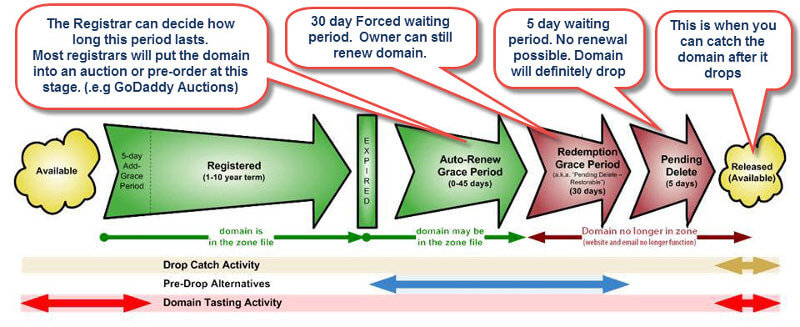
Domain Backorder Lifecycle
The above image has been taken from the Icann website with a few addons by us. You can see the pending delete stage in the domain lifecycle.
If the image is confusing for you, here's the full picture of what happens when a domain expires.
| Stage | What Happens | Duration |
| Active | Domain is registered and working | Until expiry date |
| Expired | Domain stops working, registrar holds it | 0-45 days |
| Redemption Grace Period | Owner can still recover the domain by paying extra fees | Up to 30 days |
| Pending Delete | Registry takes over, deletion is scheduled, and no recovery is possible at this stage | 5-10 days |
| Released | Domain is deleted and open for registration again (available for public to buy) | Immediate |
Now, each stage before pending delete gives the owner a chance to act and renew the domain. But by the time a domain hits the pending delete stage, every one of those chances has passed. The registry has made its final call, and the domain is heading toward release with no exceptions.
How Long Does Pending Delete Last?
One of the most common questions people ask about pending delete domains is how long it takes before the domain becomes available for registration again.
In most cases, the pending delete phase lasts between 5 and 10 days. The exact timing depends on the registry managing the domain.
During this window, the domain sits in a queue, and nothing can be done with it. The previous owner cannot step in, no registrar can process any requests for it, and availability checks will show it as unavailable even though nobody owns it currently.
On day 5, the registry begins releasing domains. Most domains drop within this 5-10 day window, but as we said, the precise moment varies. Because registries never publish precise drop times, investors and domain hunters rely on backorder services that continuously monitor pending delete domains and attempt to register them the moment they are released.
Once the deletion completes, the domain moves out of pending delete instantly. That transition from deleted to available happens in seconds, which is why high-value expired domains can disappear immediately after dropping.
Why Pending Delete Domains Matter
A fresh domain starts from zero as there is no history, authority, backlinks, or traffic. But a pending delete domain can already have all four built in.
Here are the benefits that pending delete domains offer:
Backlinks: When a domain has been around for years, other websites have likely linked to it. Those links don't disappear when the domain expires. Whoever registers it next inherits that link profile, which can give a new site a head start in search rankings.
Existing Traffic: Some expired domains still receive direct visitors who bookmarked the old site or followed an outdated link. Depending on the domain, this can mean immediate traffic from day one.
Domain Age and Authority: Search engines like Google factor in how long a domain has existed. An older domain with a clean history carries more weight than a brand-new one. Expired domains also pass the sandbox period, during which Google closely monitors new websites before ranking them higher in search results.
Brandable Names: We all know how hard it is to find good domain names. Pending delete releases names that would otherwise never become available, including short, memorable, and niche-specific options.
Now, the other reason these domains matter is certainty. Earlier expiration stages offer no guarantee that the domain will ever be released to the public. The owner can always come back and renew the domain. But once a domain passes the pending delete stage, it will be released to register again.
At this point, you know the domain will become available, so your time, effort, and money are not being wasted on a domain that might never drop.
How to Buy a Pending Delete Domain
You cannot buy a pending delete domain directly as it is not available yet, and no registrar will process a registration request until deletion completes. The only way to buy a pending delete domain is through a backorder.
What is a Backorder?
A backorder is a reservation you place with a service that monitors pending delete domains and attempts to register one the moment the registry releases it.
Think of it like this. A popular restaurant has no tables available, but you put your name on the waitlist. The moment a table opens up, the host seats you before walk-ins get a chance. A backorder works the same way, except the process is fully automated and happens in milliseconds.
How it Works
Say you want to open a coffee business and find a domain like "freshroastery.com" sitting in the pending delete queue. Since you can't register the domain yourself, you use a backorder service to buy it. Here's how the backorder service works:
- You place a backorder on a platform like NameJet or Dropcatch.
- Their system monitors the domain continuously.
- The moment the registry deletes it and marks it available, their system sends a registration request.
- If successful, the domain moves to your account.
The entire capture happens in seconds. Without a backorder service, you'd have to manually check and attempt registration yourself, and by then someone else has already grabbed it.
Where to Place a Backorder
Now, there are many platforms that offer backorder services, such as:
It’s important to keep in mind that the pricing models of all the platforms mentioned above are different. Some of these, like NameJet and Dropcatch, only charge if they successfully grab the domain for you. While other platforms like Dynadot collect a fee upfront regardless of the result. So always check the pricing terms before committing.
What Happens When Multiple People Want the Same Domain
What if you're not the only one who wants the domain?
Domains with good backlinks, steady traffic, and a long history attract multiple buyers. When such a domain enters the pending delete stage, a lot of people place backorders on different platforms. And when the domain finally drops, all those platforms try to register it at the same time.
In this case, the domain goes straight to auction where everyone places their bids, and the highest one wins. The final price can go well above the standard backorder fee, sometimes into hundreds or thousands of dollars for a sought-after name.
That’s why we suggest setting a budget before you start bidding. It's very easy to overpay when you're competing against others for the same domain.
What to Watch Out For When Buying Pending Delete Domains
Not every pending delete domain is worth your money and energy. Here's what to look at before placing a backorder or entering an auction.
The Domain's Past Can Work Against You
Previous owners may have used the domain for spam, link schemes, or completely unrelated niches. If the site was penalized before it expired, that history carries over to whoever registers it next.
Look up the domain on Wayback Machine and see what the site actually looked like. A domain that was running a link farm two years ago is not a foundation you want to build on.
Backlinks Quantity Means Nothing Without Quality
We’ve heard the “backlink quantity vs. quality” debate so many times that we even created a separate guide about it. But let’s hear it one more time: a large backlink count may sound appealing, but the quality of those links is what actually matters. Thousands of links from spammy or irrelevant sites will drag your rankings down, not push them up.
Run the backlinks through the Ahrefs or SEMrush Backlink Checker (both tools are free). Look at where the links originate, whether the linking sites are relevant, and if the growth pattern looks natural.
Trademarked Names Are a Legal Risk
Some expired domains include brand names or protected terms. For example, domains containing names like “Nike,” “Tesla,” “Netflix,” or slight variations of them can create legal problems. Even adding extra words such as “shop,” “deals,” or “online” does not make them safe to use.
Registering such domains puts you at risk of a UDRP complaint, which can result in losing the domain entirely with no refund. Always check trademark databases before committing to any name that resembles an existing brand.
A Backorder Is a Shot, Not a Guarantee
A backorder does not guarantee that you will get the domain. Another platform may catch the domain first, or an auction could push the final price beyond what you are willing to pay. Some services also charge a fee whether they succeed or not, so placing backorders on multiple domains at once adds up quickly.
Drop Timing Is Unpredictable
Registries don't release domains on a fixed public schedule. The drop can happen at any point during the 5-10 day window, at any hour. Manually tracking this is impractical, which is exactly why backorder services exist. Let the automation handle it, but know going in that the timing is outside your control.
Conclusion
To recap, pending delete is the final stage before an expired domain becomes available to the public. By the time a domain reaches this point, the previous owner is completely out of the picture and release is guaranteed.
Domains with years of backlinks, traffic, and authority become available through this process every single day. Buying pending delete domains at the right price can save months of SEO work compared to starting with a new domain.
With that said, the process rewards preparation. Know what you're buying before you bid, use backorder services to handle the technical side, and set a budget you're comfortable with before stepping into a competitive auction.
FAQs
What is a pending delete domain?
A pending delete domain has completed the full expiration process and is scheduled for deletion by the registry. The previous owner has lost all rights to it and no one can renew, restore, or transfer it. Once the deletion completes, the domain becomes available for anyone to register.
How long is a domain pending delete?
The pending delete period lasts between 5 and 10 days, depending on the registry.
How to buy a pending delete domain?
You cannot register a pending delete domain directly since it isn't available yet. The way to acquire one is by placing a backorder through a service that monitors the domain and attempts registration the moment it drops. If multiple services catch the same domain, it goes to auction.
What are the best backorder services?
GoDaddy Auctions, NameJet, Snapnames, Dropcatch, and Dynadot are among the most used backorder platforms. Each service has its own pricing model and success rate, so using multiple services for the same domain increases your chances of securing it.
What does client transfer prohibited pending delete mean?
This is a domain status that locks the domain from being transferred to another registrar while it moves through the deletion process. It is a standard registry setting applied automatically during pending delete.