 DomCop
Starting a brand new website usually feels like shouting into a void. You buy a fresh domain, post great content, and then wait months for search engines to notice you.
An expired domain changes that game completely. These are web addresses that were once active but were not renewed by their previous owners. When you perform a smart expired domain name search, you are essentially buying a head start.
The real secret lies in inheriting “link juice” and a proven history. This helps you skip the “Google Sandbox,” which is the frustrating period where Google keeps new sites from ranking well while it builds trust.
In this guide, we will show you exactly how to perform an expired domain name search to find gold domains and grow your business faster.
The Power of Buying Expired Domains
Most people start their websites from scratch, but most people aren’t as smart as you… That said, when you perform an expired domain name search, you are looking for a domain that already holds value. Instead of waiting years for search engines to trust you, you can buy a website that has already earned its reputation.
Instant Authority
One of the biggest perks here is gaining immediate authority. While a brand-new website starts with a Domain Authority (DA) or Domain Rating (DR) of nothing, an expired domain name search helps you find names that already have established scores. These metrics are built on years of history. They tell search engines that your site is a reliable source of information the moment you launch it.
Existing Backlinks
Building backlinks from scratch is one of the hardest parts of SEO. It usually involves endless outreach and high costs. However, a successful expired domain name search often leads you to a domain that already has a library of links from reputable sites. You get to keep that power without doing any of the heavy lifting. This existing “link juice” flows directly into your new project and helps you rank much faster.
Residual Traffic
Sometimes, an expired domain still gets visitors even after the original owner lets it go. This happens because people are still clicking on old bookmarks or links found on other blogs and forums. When you do a targeted expired domain name search, you might find a domain that brings in immediate visitors. This means you can get eyes on your content or products from day one without waiting for search engines to crawl your site.
Expired Domain Name Search In 5 Simple Steps
Let’s understand how to perform an expired domain name search in just five steps:
Step 1: Start Your Search with DomCop

To find the best domains without wasting hours of your time, you need a powerful tool to do the heavy lifting. This is where DomCop comes in. It is a specialized platform designed to help you navigate the massive world of available web addresses. Rather than manually checking thousands of options, you can use the platform to perform a highly targeted expired domain name search that uncovers gems in seconds.
Navigating the Main Lists
When you log in, you will notice three main categories to help organize your expired domain name search.

The “Expiring” list shows you domains that are currently in an auction phase. The “Expired” list features domains that have already dropped and are ready for registration. Finally, the “Archived” list contains domains that were seen in the past.
Understanding these lists helps you decide whether you want to bid against others or simply buy a domain at a fixed price.
Simple vs. Advanced Searches
DomCop caters to both beginners and pros. If you are new to the process, the “Simple” search mode lets you find great domains by looking at basic metrics like price and industry.
If you have specific goals, the “Advanced” search is a game-changer. It allows you to refine your expired domain name search using over 40 different metrics from top SEO tools. You can filter by backlink counts, social media shares, or even specific domain extensions to find exactly what you need.

Step 2: Filter for High-Quality Metrics
Finding a large list of domains is easy, but finding the ones that actually move the needle for your SEO takes a bit more precision. You don’t want to buy every name you see. That’s why you should use specific metrics to separate the powerful assets from the junk. When you run an expired domain name search, these filters act as your first line of defense against low-quality sites.
SEO Metrics
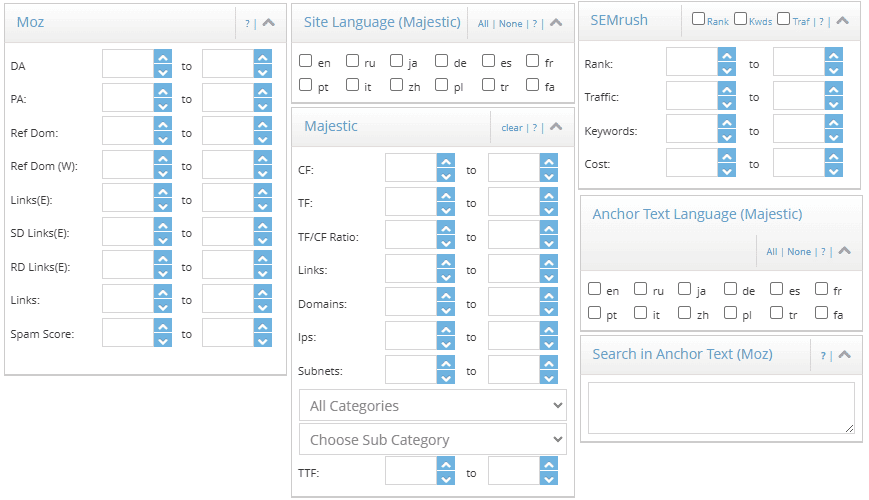
To judge the strength of a domain, you need to look at industry-standard numbers. DomCop integrates data from Moz and Majestic, giving you a clear picture of a domain’s power. For a strong start, look for a Domain Authority (DA) of at least 20. You should also check Majestic’s Trust Flow (TF) and Citation Flow (CF). A good rule of thumb is to look for a “Trust Ratio” where TF and CF are close to each other. If a domain has a high Citation Flow but a very low Trust Flow, it is often a sign of a spammy link profile.
Relevance
Authority is great, but relevance is what makes it work. If you are building a site about organic gardening, a high-authority domain that used to be a car repair shop won’t help you much. Search engines are smart enough to see the disconnect.
During your expired domain name search, try to find names that fit your niche. When the historical topic of the domain matches your new content, the “link juice” flows much more effectively, and you gain topical authority almost instantly.
Domain Age
In the world of SEO, age often equals trust. Older domains are generally viewed more favorably by search engines because they have a documented history of being active. This longevity suggests that the site was a stable part of the web. While domain age isn’t the only factor, including it in your expired domain name search can help you find expired domains that have long-standing relationships with other authoritative websites.
Keyword Filters

One of the most efficient ways to narrow your list is by using keyword filters. Within DomCop, you can set keyword filters to only show domains that contain specific words related to your business. For example, if you are in the skincare industry, you can filter for names containing “glow,” “skin,” or “beauty.” This confirms that your new domain is not only powerful but also perfectly branded for your target audience.
Step 3: Vetting the Domain History (The No-Spam Check)
Think of a domain like a used car. The paint might look shiny, and the mileage might look low, but you really need to see the accident report before you buy. A domain carries its past with it, and search engines have long memories. If the previous owner used it for shady activities, you could be inheriting a hidden penalty that makes it impossible for your new content to rank.
Checking the history is the most critical part of your expired domain name search because it protects your investment from invisible damage.
Wayback Machine
You can easily peek into the past using the Wayback Machine. This tool shows you screenshots of what the website looked like years ago.
When you are deep into an expired domain name search, browse through several years of snapshots. You are looking for consistency. If a site was about cooking for five years and then suddenly turned into a hub for gambling or cheap pharmaceuticals, that is a massive red flag. A clean history shows a site that provided value to users without trying to cheat the system.
Backlink Audit
The strength of your domain lives in its backlink profile, but quality matters much more than quantity. Some domains have thousands of links purchased from link farms or generated by bots.
During your search, use a tool to look at the anchor text of these links. If you see repetitive, commercial keywords in foreign languages that don’t match the site’s topic, stay away. Healthy domains have links from real blogs, news sites, and forums that naturally mention the brand.
Google Index Status
Another quick way to test a domain’s health is to check whether Google still recognizes it. Head to a search bar and type “site:example.com” to see what comes up. If you see several pages listed, it means Google still trusts the domain enough to keep it in the index.
On the other hand, if your expired domain name search reveals a domain with great metrics but zero indexed pages, be very careful. It might have been manually removed by Google due to spam, which is a headache you definitely want to avoid.
Step 4: Acquiring the Domain
After you finish your expired domain name search and pick a winner, you need to know how to actually claim it. Domains move through different stages, and the way you buy them depends on where they are in that cycle. Understanding these paths ensures you don’t miss out on a high-value name just because you were looking in the wrong place.
Auctions
The most valuable names rarely reach the open market because they are snapped up in auctions first. This happens when a domain expires at a specific registrar, and that company decides to sell it to the highest bidder.
If your expired domain name search points toward a high-authority site, you will likely find it on platforms like GoDaddy Auctions, Dynadot, or Sedo. You will need to create an account and place bids against other investors. Keep a close eye on the clock, as these battles often heat up in the final minutes.
Backordering
Sometimes a domain is about to be deleted, but hasn’t reached the public yet. In this situation, you can use a backorder service to catch the domain the moment it drops. Services like DropCatch or NameJet use high-speed software to grab these names faster than any human could.
If your expired domain name search reveals a specific domain that is “pending delete,” placing a backorder is the most reliable way to secure it before someone else does. You usually only pay the full fee if the service successfully grabs the name for you.
Direct Registration
If a domain goes through the entire expiration process without being bought or backordered, it becomes available for anyone to register at standard prices. These are called “dropped” domains. You can pick these up using your preferred registrar, such as Namecheap, Google Domains, or Cloudflare.
While the most famous names are usually snatched up earlier, a clever expired domain name search can still help you find hidden gems that other people missed. This is the most budget-friendly way to acquire an aged domain with a solid history.
Step 5: Putting Your New Domain to Work
Once you have secured your domain, you need a plan to activate its power. Owning a high-authority domain is only the first half of the battle. The second half is choosing a strategy that tells search engines how to treat the transition. There are three main ways to use an expired domain to boost your rankings.
The 301 Redirect
This is the most popular method for a quick SEO boost. A 301 redirect is a permanent instruction that sends visitors and search engine bots from the expired domain directly to your existing website. By doing this, you pass the link juice and authority from the old domain to your own.
For the best results, you should map specific pages. If the expired domain had a popular page about “hiking boots,” redirect that specific URL to your own page about hiking gear rather than just sending everything to your homepage.
Building a New Site
If you don’t have an existing site to boost, you can launch a fresh project directly on the expired domain. This allows you to skip the Google Sandbox period and start ranking your content much faster than you would with a brand-new name. Since search engines like Google already trust the domain, your new articles are likely to be indexed and ranked quickly.
The key here is to keep the content relevant to the domain’s past topic. If the site used to be a tech blog, continuing with tech-related content will help maintain its established authority.
The PBN Approach
A Private Blog Network (PBN) involves building a small network of sites that all link back to your main money site. You use expired domains to create these network sites because they already have the power to influence rankings.
While this can be a very effective way to control your own backlink profile, it does come with a lot of risks. You must host these sites on separate IP addresses and confirm they appear as independent, high-quality blogs. This strategy requires more maintenance, but it gives you total control over the links pointing to your business.
3 Most Common Pitfalls to Avoid
Even the most promising domain can be a bad investment if you don’t know what to look for. While the rewards are high, the risks are real. Being aware of these common traps will help you filter your results during an expired domain name search and keep your projects safe from future trouble.
The Google Ban Trap to Avoid
One of the scariest things you can run into is a domain that has been permanently banned by Google. This usually happens because the previous owner used “black hat” SEO techniques or hosted harmful content. If a domain is banned, your new content will never show up in search results, no matter how good it is.
To avoid this during your expired domain name search, use the Google Transparency Report or a “Banned Site Checker.” If a domain has a history of manual actions or a high spam score, it is best to leave it alone.
The Trademark Risk
Just because a domain is available doesn’t mean you have the legal right to use it. Many expired domains contain brand-heavy names or trademarked terms. If you buy a domain like “NikeDeals.com” or “iPhoneTips.net,” you are inviting a legal headache. The original trademark owners can file a dispute to regain the domain, often without paying you a cent.
When performing an expired domain name search, try to stick to generic or descriptive terms. You can also use the USPTO database to check if a specific name is legally protected.
Fake Metrics — Yes, They Exist
Not every high-authority domain is actually powerful. Some sellers use “redirect hacks” to artificially inflate scores like Domain Authority (DA) or Domain Rating (DR). They might point thousands of low-quality links to a redirect page to trick SEO tools into showing a high score.
During your expired domain name search, always look past the single number. Check the actual backlink list. If a domain has a DA of 50 but only has links from random, unrelated sites, the authority is likely fake.
Conclusion
Finding a great expired domain takes patience. You now have a clear path to follow, from checking history to avoiding legal traps. This entire process is much faster when you have the right data. A thorough expired domain name search helps you skip the guesswork and find names that hold real power.
DomCop makes this simple. It filters through millions of options to show you only the best candidates. It handles the complicated metrics so you can spend your time building your business. Once you find a winner and check its past, you can launch your project with authority. That is something that usually takes years to earn.