
PBN stands for private blog network: a group of websites one owner controls and uses to link to a main site, the money site, to help it rank. PBNs are against Google's guidelines and carry a real risk of a penalty.
People still build them, and they work when built carefully. This page answers the safety questions plainly and ends on how to lower the risk.
What does PBN stand for?
PBN means private blog network. "Private" means the owner keeps the sites to themselves and sells no links on them, unlike a public blog network where anyone can buy a link.
Most PBN sites are built on expired domains that still have strong backlinks, so each link to the money site carries the authority of those old links. Our guide to building a private blog network covers the method step by step.
Are PBNs safe?
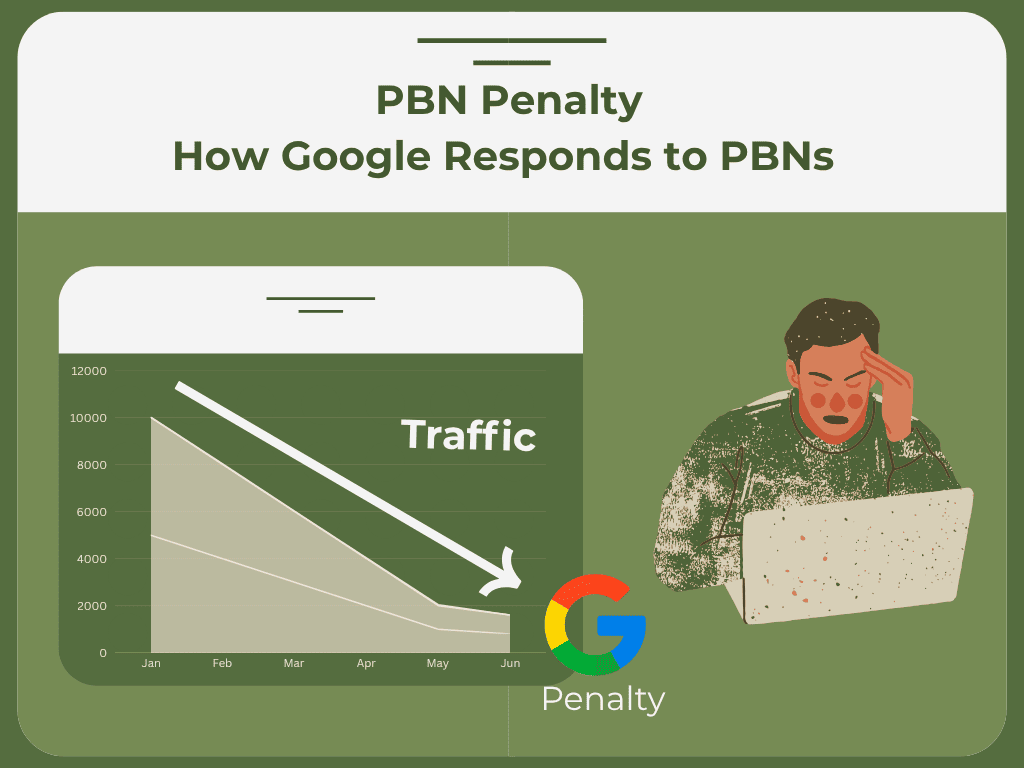
No PBN is fully safe. Links built to manipulate rankings break Google's link spam policy, and a network that is found can lose its value overnight.
How large the risk is depends on how the network is built. A network of real-looking sites on clean domains with no shared footprints is hard to find, while a cheap network on spammy domains is easy to find.
Do PBNs still work in 2026?
Yes, when they are built carefully. Links from relevant sites with strong backlink profiles still move rankings, and a PBN gives the owner full control over the anchor text, the page and the timing of each link.
They stop working when the footprints show. Google's systems discount links they recognize as link spam, and a manual reviewer who sees a pattern can act against the money site.
- What still works: few sites, each run like a real site, on domains with clean history and backlinks in the same niche, linking slowly and in context.
- What gets caught: public networks that sell links, spun content, sites that share hosts or accounts, and domains that were spam or a PBN before.
How Google detects PBNs
Google finds PBNs through footprints: patterns that tie the sites to each other or to the money site. Its algorithms (SpamBrain among them) look for these patterns at scale, and human reviewers check sites that look suspicious.
- Selling links: a Google employee can buy a link from a public network and trace every site in it.
- Shared hosting: many sites on one IP address, one subnet or a host that sells "SEO hosting".
- Shared ownership data: the same WHOIS details, registrar or name servers across many domains.
- Shared accounts: one Google Analytics or Search Console account for several sites.
- Blocking crawlers: ordinary sites rarely block Ahrefs, Majestic and Moz, so sites that do stand out.
- Thin or spun content: pages written only to hold a link invite a manual review.
- Anchor text: exact-match commercial anchors on most links, where a natural profile is mostly brand names and URLs.
- Link velocity: a sudden spike of links over a few days instead of slow growth.
- No outbound links: sites that link only to the money site and to nothing else useful.
- A penalized domain: a domain that was spam or part of a caught network before you bought it.
- Talking about it: owners who say in public which sites they own.
What a PBN penalty does
When Google finds a network, the PBN sites can be de-indexed and their links ignored. The money site can lose rankings, and a manual action for unnatural links can push it out of the results.
Manual and algorithmic penalties
A manual action comes from a human reviewer and shows in Search Console under Manual Actions. It is lifted only after the links are removed or disavowed and a reconsideration request is accepted, which usually takes weeks.
An algorithmic loss has no notice. The links simply stop counting, and recovery depends on replacing them with links Google trusts, which can take months.
The cost of recovery
Recovery takes time and money, and there is no guarantee it works. These are the usual steps:
- Audit: list every link from the network and every other link that looks manipulative.
- Remove or disavow: take down the links you control and submit the rest to Google's disavow tool.
- Reconsideration request: for a manual action, explain what you found, what you removed and ask Google to review the site.
For a business that relies on search traffic, the lost revenue during that time is usually the larger cost. See Google penalties for how to check a site for one.
How to lower the risk of a PBN
Most networks that get caught were built on bad domains or left obvious footprints. Both can be avoided before you spend money on content.
Start with a clean domain history
Check every domain in the Wayback Machine for spam, foreign-language content, a sudden topic change or a past as a PBN. Skip any domain that looks like it was used for link schemes, however good its numbers are.
Run a site: search to see whether Google still indexes it, and read how to check a domain's history for the full method.
Buy on real metrics, not inflated ones
Look at the backlinks by hand, not only at the score. A TF/CF ratio close to 1, a Topical Trust Flow in your niche and many referring domains are signs of real links; a high Citation Flow with a low Trust Flow often means fake backlinks.
DomCop shows Moz DA, Majestic Trust Flow, Citation Flow and Topical Trust Flow, Ahrefs DR, referring domains and Wayback age on every name. The PBN domains list lets you rule out the domains that get a network caught before you bid, and buying PBN domains explains what to check.
Leave no footprints
- Hosting: different hosts and IP ranges, never a host sold as PBN hosting.
- Registrars: different registrars and their own name servers, with WHOIS privacy.
- Accounts: no shared analytics, Search Console or ad accounts.
- Crawlers: block none of them, as a normal site would not.
- Content: real articles in the domain's old niche, with links out to other useful sites.
- Links: one contextual link per site to the money site, varied anchors, added slowly.
- Silence: sell no links and tell no one which sites you own.
The PBN rules in our guide go through each of these in detail.
PBN FAQs
What does PBNs stand for?
PBNs stands for private blog networks. Each one is a group of sites owned by one person or company and used to link to a money site.
Are PBN domains safe to buy?
A domain is as safe as its history. Buy only domains with clean Wayback history, real backlinks and no sign of a past penalty or network.
Is a PBN black hat or grey hat?
A PBN is black hat. Google treats links built to manipulate rankings as link spam, whoever owns the sites.
Does Google punish the whole network or just the money site?
It can do both. The PBN sites can be de-indexed and the money site can lose rankings or get a manual action.
Can my site be linked to a PBN without my knowledge?
Yes, a competitor can point spammy links at your site. Check your backlinks from time to time and disavow links you do not recognize if a manual action appears.
How long does a PBN penalty last?
A manual action lasts until a reconsideration request is accepted, which usually takes weeks after the cleanup. An algorithmic loss lasts until the site earns links Google trusts, often months.