 DomCop
How much would you pay for a head start on Google? For many website owners, the answer is found in expired domains.
Instead of waiting months or years to build trust from zero, buying an aged domain lets you use its existing backlink profile and established history immediately. However, the process is risky. For every high-quality name available, there are hundreds of spam-filled options that can lead to search engine penalties.
To find a safe and powerful asset, you need reliable data. This guide covers the 7 best expired domain tools to help you find valuable names with clean histories.
What are Expired Domain Tools?
When a website owner forgets to renew their web address, it eventually returns to the public market. Expired domain tools are specialized search engines that track these names as they become available.
Instead of manually searching, expired domain tools crawl millions of records from registrars and auction sites to show you which domains are currently dropping. Most importantly, they provide data on important metrics that indicate a domain’s power:
- Domain Authority (DA) and Rating (DR): Scores from Moz and Ahrefs that estimate how well a site will rank.
- Trust Flow (TF): A Majestic metric that measures the quality and reliability of the backlinks.
- Backlink Profile: A list of other websites currently linking to that domain.
- Spam Score: A check to see if the domain was used for “black hat” SEO or low-quality content in the past.
By using these tools, you can filter through the noise and only bid on names that will actually help your search rankings.
7 Expired Domain Tools For Finding High-Quality Domains
Finding the right domain name requires a balance of SEO metrics and safety checks. Here are the top expired domain tools to help you identify valuable assets without the fluff.
| Tool | Type | Best For | Price (Starting) | Key Strength |
| DomCop | Web App | Professionals | ~$9.90/mo | 90+ SEO metrics in one place. |
| Spamzilla | Web App | Safety First | ~$37/mo | Automated spam & history checking. |
| ExpiredDomains.net | Web App | Budget Users | FREE | Massive database with no cost. |
| Domain Hunter Gatherer | Desktop | Scrapers | ~$17/mo | Finding domains by crawling live sites. |
| Instant Domain Search | Web App | Brainstorming | FREE | Speed and real-time results. |
| GoDaddy Auctions | Marketplace | Premium Names | ~$5/year | Buying aged domains directly from a registrar. |
| Register Compass | Web App | Power Users | ~$37/mo | Deep integration with multiple auctions. |
Let’s discuss these expired domain tools in detail:
1. DomCop
Best For: High-volume filtering and deep data analysis.
Price: Newbie Plan: $816/yr | Power Plan: $1,152/yr | Guru Plan: $1,416/yr
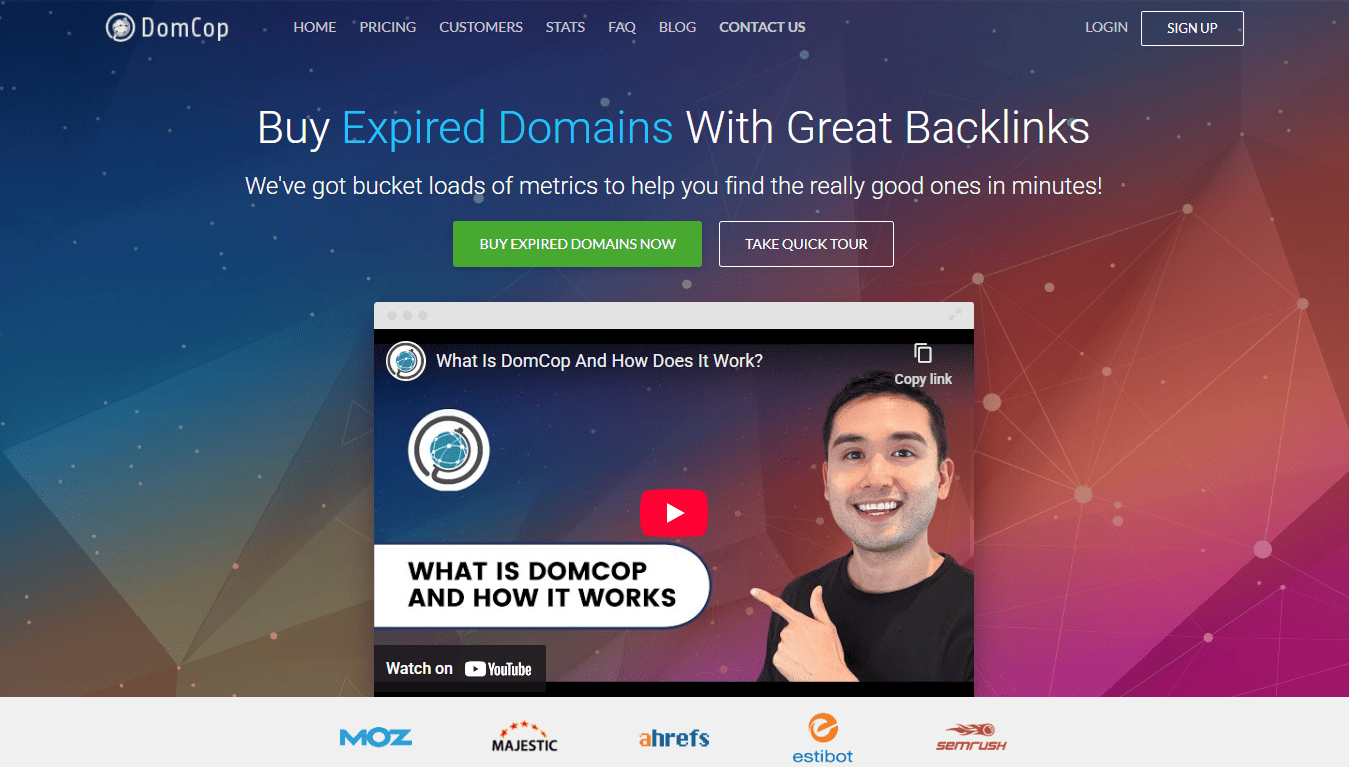
DomCop is widely considered the industry giant for finding expired domains. It doesn’t sell the domains itself; instead, it acts as a massive search engine that aggregates data from auction houses like GoDaddy, NameJet, Dynadot, and many more.
If you are looking for a high-volume tool that does the heavy lifting of gathering metrics, this is usually the first stop for professionals.
Features:
- 90+ SEO Metrics: It pulls data from every major provider, including Majestic (TF/CF), Moz (DA/PA), SEMrush (Traffic), and even social media share counts.
- Personal Crawler: For Guru plan users, DomCop provides a private crawler that finds expired domains by scanning existing websites for broken links.
- Auction Integration: It tracks active auctions in real-time, so you can see exactly when a bidding war for a high-value domain is ending.
- Advanced Filtering: DomCop filters are a powerful feature on their own. You can refine your search by domain age, specific TLDs (such as .com or .net), and even the amount of traffic a domain currently receives.
Pros:
- Massive Database: DomCop tracks more than 10 million domains daily to give you a significantly higher chance of finding the best domain than smaller tools.
- Time Efficiency: Having all metrics (Moz, Majestic, etc.) on one screen saves you from manually checking every domain on different sites.
- Custom Alerts: You can set up watchlists to get notified the second a domain matching your criteria hits the market.
Cons:
- No Free Tier: Unlike some competitors in this list, DomCop is strictly a paid tool. They offer a 2-day money-back guarantee, but you have to pay upfront to see the best data.
- Dated Interface: The dashboard looks a bit like a spreadsheet from 2010. It is functional but can feel cluttered and overwhelming for a beginner.
- High Competition: Because it’s so popular, the high-authority domains you find on DomCop are usually spotted by hundreds of other professional buyers, driving up auction prices.
Is DomCop Worth It?
DomCop is the best tool for power users and PBN (Private Blog Network) builders who have a budget. If you are looking for a freebie or a “one-off” domain for a personal blog, the cost might be hard to justify. But if you’re a professional domain flipper or an SEO agency, the depth of data is worth every penny.
2. Spamzilla
Spamzilla
Best For: Automated spam checking and historical data.
Price: $0/mo (never billed) | Standard Plan: $37/mo (billed monthly)
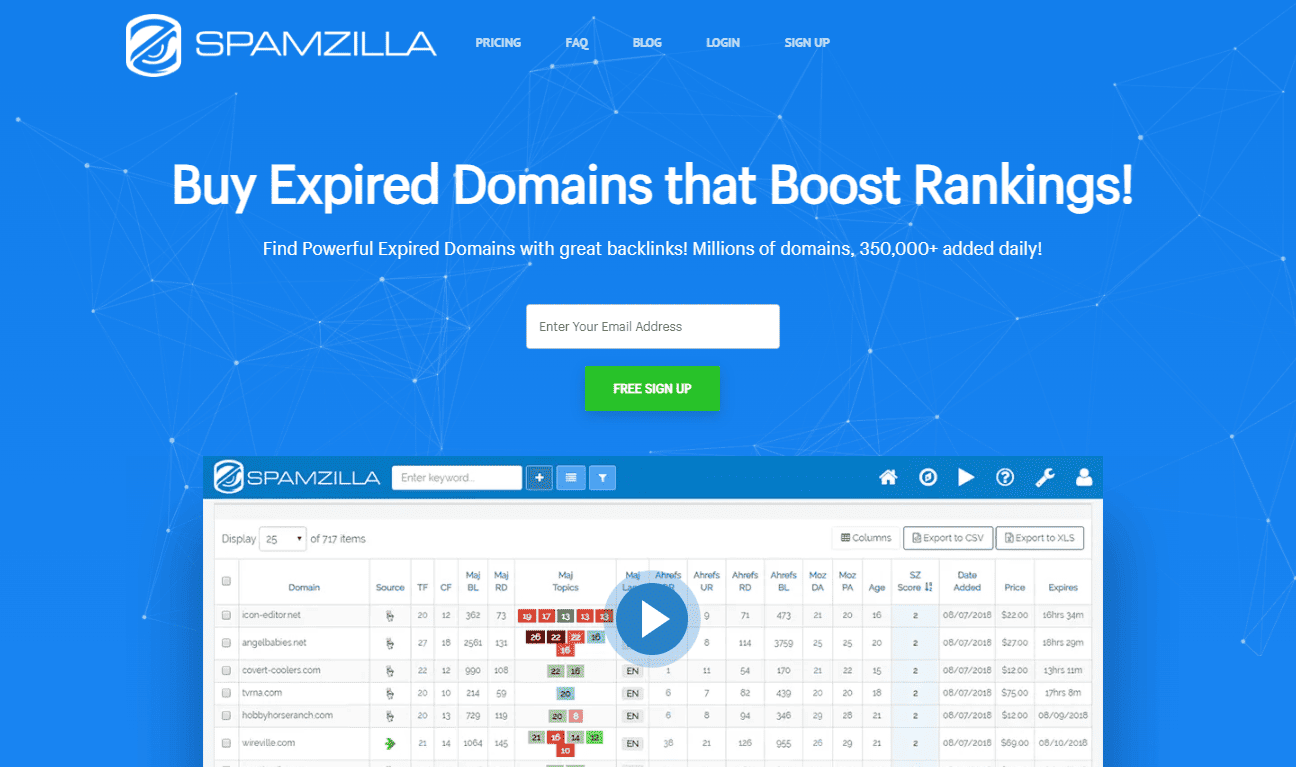
If DomCop is the giant of data, Spamzilla is the expert in safety. This tool was built specifically to solve the biggest problem in the expired domain market: spam.
Many domains look great on paper (high DR or DA) but were artificially boosted by previous owners. Spamzilla uses automated algorithms to scan a domain’s entire history so you don’t buy a penalized asset.
Features:
- Proprietary Spam Score: Every domain is given a score from 1 to 100 based on its history. A lower score means a cleaner domain.
- Wayback Machine Integration: It automatically pulls old snapshots of the website. You can see if the domain was ever used for a Chinese pharmacy, a gambling site, or a low-quality PBN.
- Backlink Miner: This feature lets you instantly view the top 100+ backlinks for a domain, checking anchor text language and link quality.
- Bulk Domain Analysis: If you have your own list of domains (from a crawler or another tool), you can upload up to 1,850 of them per month to check for spam in bulk.
Pros:
- Saves Massive Time: Manually checking the Wayback Machine and backlink history for 50 domains would take hours; Spamzilla does it in seconds.
- Daily Email Alerts: You can set custom filters (e.g., “Must be .com, DR > 20, Spam Score < 10”) and get a list of new matches sent to your inbox daily.
- Clean Interface: Compared to DomCop, Spamzilla has a much more modern and intuitive user interface that is easier for beginners to navigate.
Cons:
- Limited Free Version: The free tier only allows you to review 25 domains. To access the actual database of millions of domains, you must pay.
- The “Spam Score” Isn’t Perfect: While the score is helpful, it’s still an algorithm. Sometimes a clean domain gets a high score by mistake, and occasionally, a sneaky spammy domain slips through with a low score.
- Monthly Subscription: At approximately $37 per month, it is an ongoing cost that might be steep for someone looking for just one domain.
Is Spamzilla Worth it?
Spamzilla is the best tool for safety-conscious SEOs. If you are terrified of buying a domain that Google has blacklisted, this tool is your best insurance policy. It’s perfect for those who prioritize quality and “cleanliness” over sheer volume. In short, it’s a yes.
3. ExpiredDomains.net
ExpiredDomains.net
Best For: Users on a budget who want access to a raw database.
Price: Free
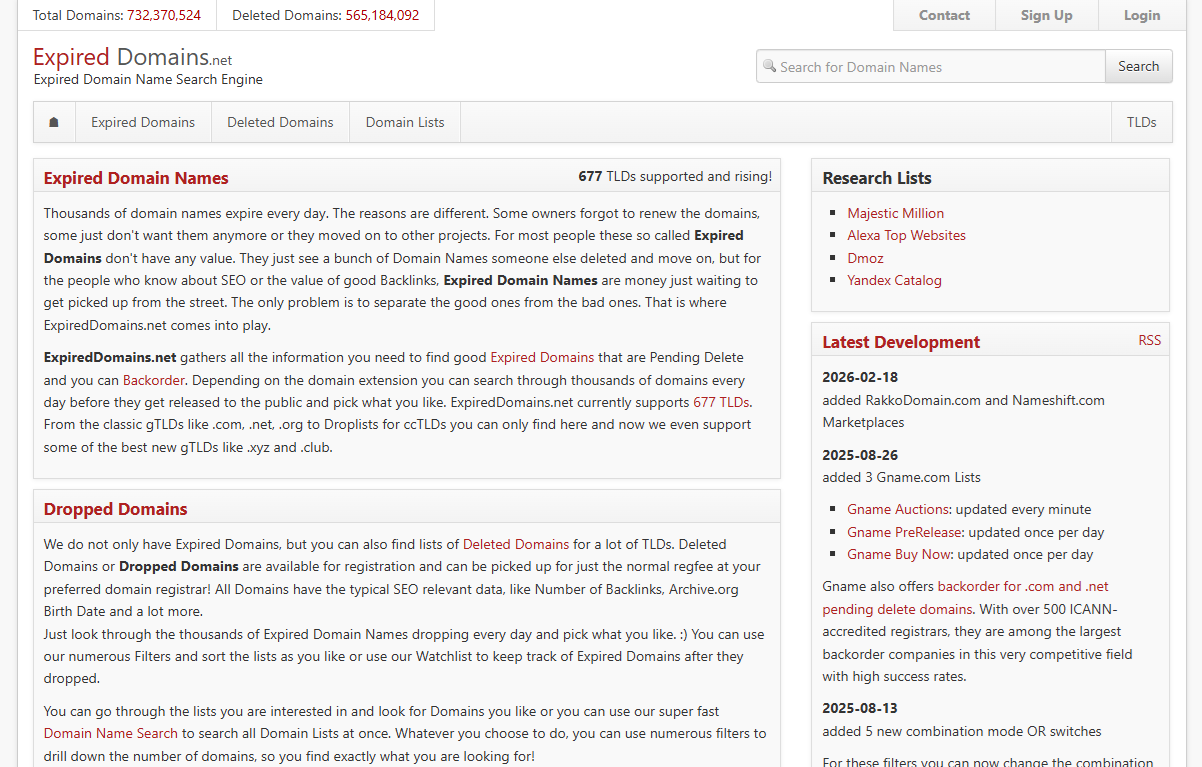
If you have spent any time in the SEO world, you have likely heard of ExpiredDomains.net. It is the largest and most famous free tool in the industry. While it doesn’t have the flashy design of modern apps, its power lies in its massive database and the fact that it costs absolutely nothing to use. It is essentially a search engine for every domain name that has ever been registered and dropped.
Features:
- Massive TLD Support: It tracks 700+ different Top-Level Domains (TLDs), from common ones like .com and .net to country codes and new extensions like .xyz or .app.
- Comprehensive Filtering: The “Show Filter” button is where the magic happens. You can filter by backlink count, domain age (WBY), character length, presence of numbers or hyphens, and even whether the domain is in the English dictionary.
- Marketplace Integration: It lists domains from all major auction sites, including GoDaddy, NameJet, SnapNames, and Dynadot, all in one central dashboard.
- Watchlists: You can save interesting domains to a personal watchlist to track their status as they move from “pending delete” to “available.”
Pros:
- 100% Free: It’s a free expired domain tool, so you get access to the full database and all filtering options just by creating a free account. There are no premium tiers hiding the best data.
- Largest Database in the World: With more than 700 million domains currently in the system, it is the most exhaustive resource available. If a domain exists, it’s likely here.
- Data Export: You can export your filtered lists into a CSV or spreadsheet for free, which is a feature most paid expired domain tools charge a premium for.
Cons:
- Dated and Clunky Interface: The website looks like it belongs in the late 90s. It can be visually overwhelming, and it isn’t optimized for mobile use at all.
- Steep Learning Curve: Because there are hundreds of filter options, beginners often feel lost. You have to know exactly what metrics (like “DP” for Domain Pop or “ABY” for Archive Birth Year) mean to use it effectively.
- No Built-in Spam Checking: This free expired domain tool doesn’t tell you if a domain is clean. You have to manually check the history yourself using the Wayback Machine or other third-party SEO tools. And you can imagine how many hours that can take.
Is ExpiredDomains.net Worth it?
ExpiredDomains.net is the essential tool for everyone, from beginners on a $0 budget to professionals who want raw data. It is the best place to start your search, but you should always pair it with a second tool (like a backlink checker or the Wayback Machine) to verify that the domains you find aren’t spammy.
4. Domain Hunter Gatherer
Domain Hunter Gatherer
Best For: Finding niche-specific domains and scraping competitors.
Price: $0/mo | Premium: $27/mo | Domain Hunter Gatherer Pro: $97/mo
If you Google “expired domain tools” right now, you will find this one on the very first page.
Most expired domain tools are web-based, but Domain Hunter Gatherer (DHG) is a powerful desktop software that acts as a “crawler.” Instead of just looking at a list of expired domains, it proactively searches the web for dead links on authoritative sites and checks whether the linked domains are available to register at a standard fee.
In simple words, it actively hunts for hidden domain opportunities across the internet rather than waiting for them to appear in public auction databases.
Features:
- Hunt from Keywords: Enter your niche keywords, and the software will find expired domains that are relevant to your specific industry by scraping search results.
- Authority Site Scraper: You can point the tool at a major site like Wikipedia or a news outlet. It will scan the entire site for broken outgoing links that you can buy and rescue.
- Web 2.0 Hunter: This unique feature finds expired accounts on platforms like Tumblr, Blogger, and WordPress, allowing you to reclaim old subdomains with existing authority.
- DomDetailer Integration: It includes a built-in system that pulls Majestic and Moz metrics directly into the software, so you can vet domains as they are found.
Pros:
- Finds Hidden Domains: Because it scrapes the live web, it often finds domains that haven’t yet appeared on major aggregator lists. This means less competition and lower prices.
- One-Time Cost Option: They offer a pro version that provides much more control than a standard monthly subscription service if you are a long-term user.
- All-in-One Solution: It handles everything from finding the domain to checking its stats and even helping you restore old content via the Wayback Machine.
Cons:
- Windows Only: This is a desktop application built for Windows. If you use a Mac or Linux, you will need to run a virtual machine or a VPS to use it.
- Requires Proxies: To scrape search engines effectively without getting blocked, you usually need to buy separate proxies, which adds to the total cost.
Is Domain Hunter Gatherer Worth it?
Domain Hunter Gatherer is the best choice for “DIY” SEO. If you want to avoid expensive auctions and find your own virgin expired domains by scraping, this is the most powerful software available. It is a workhorse for people building large-scale niche sites.
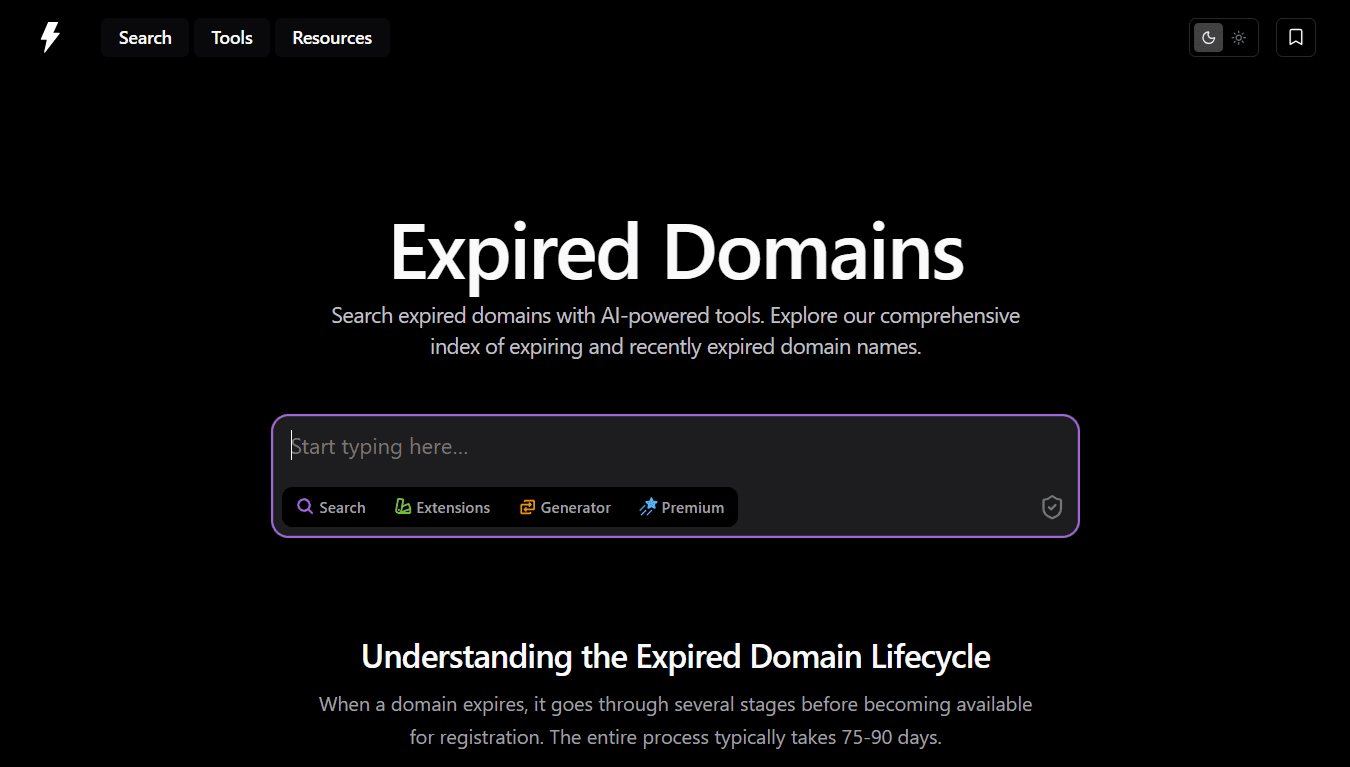
5. Instant Domain Search
Instant Domain Search
Best For: Quick availability checks and brainstorming.
Price: Instant Domain Search earns a commission when users buy domains through the registrars it links to. These referral fees help keep the site running. Searing domains here are completely free.
If you have ever felt overwhelmed by massive spreadsheets and complex filters, Instant Domain Search is the solution. It offers great speed and simplicity.
While other tools focus on deep technical archives, this platform is designed for the “hunt as you type” experience. It is the best way to quickly see if a specific brand name or keyword-rich domain is available across various states: expired, for sale, or currently in auction.
Features:
- Real-Time Search Results: As you type, the tool checks millions of records and displays availability in less than 100 milliseconds.
- Expired & Premium Database: It features a specialized tab for expired and premium domains, allowing you to see which names have just entered the grace period or are about to be released.
- Bulk Domain Checker: You can paste a list of up to 1,000 domains at once to see which are available for registration.
- AI-Powered Suggestions: If your desired expired domain is already taken, its generator uses AI to suggest the closest available alternatives with high-authority extensions like .ai, .io, or .co.
Pros:
- Unmatched Speed: There is no search button; the results appear instantly as you type. It is the best tool for high-speed brainstorming sessions.
- User-Friendly Design: The interface is clean, modern, and completely free of the cluttered spreadsheets found in older tools.
- Multi-TLD View: It shows you dozens of different domain extensions side-by-side, helping you spot opportunities in niche TLDs that you might have missed.
Cons:
- Lack of Deep SEO Metrics: This tool will tell you if a domain is available, but it won’t show you its Domain Rating (DR) or Trust Flow (TF). You’ll need a separate tool like Ahrefs or Majestic for that data.
- No Spam History: It does not provide automated spam checks or Wayback Machine snapshots. You are essentially seeing the domain’s current status, not its cleanliness.
- Referral-Based: The tool makes money by referring you to registrars like GoDaddy or Namecheap. While the search is free, you have to be careful of suggested prices that might be higher than standard registration.
Is Instant Domain Search Worth it?
Instant Domain Search is the best expired domain tool for the “Idea Phase.” It is perfect for entrepreneurs and marketers who have a list of brand names or keywords and want to see what’s available in the secondary market without the headache of complex software. Use it to find your candidates, then use a tool like Spamzilla to vet them.
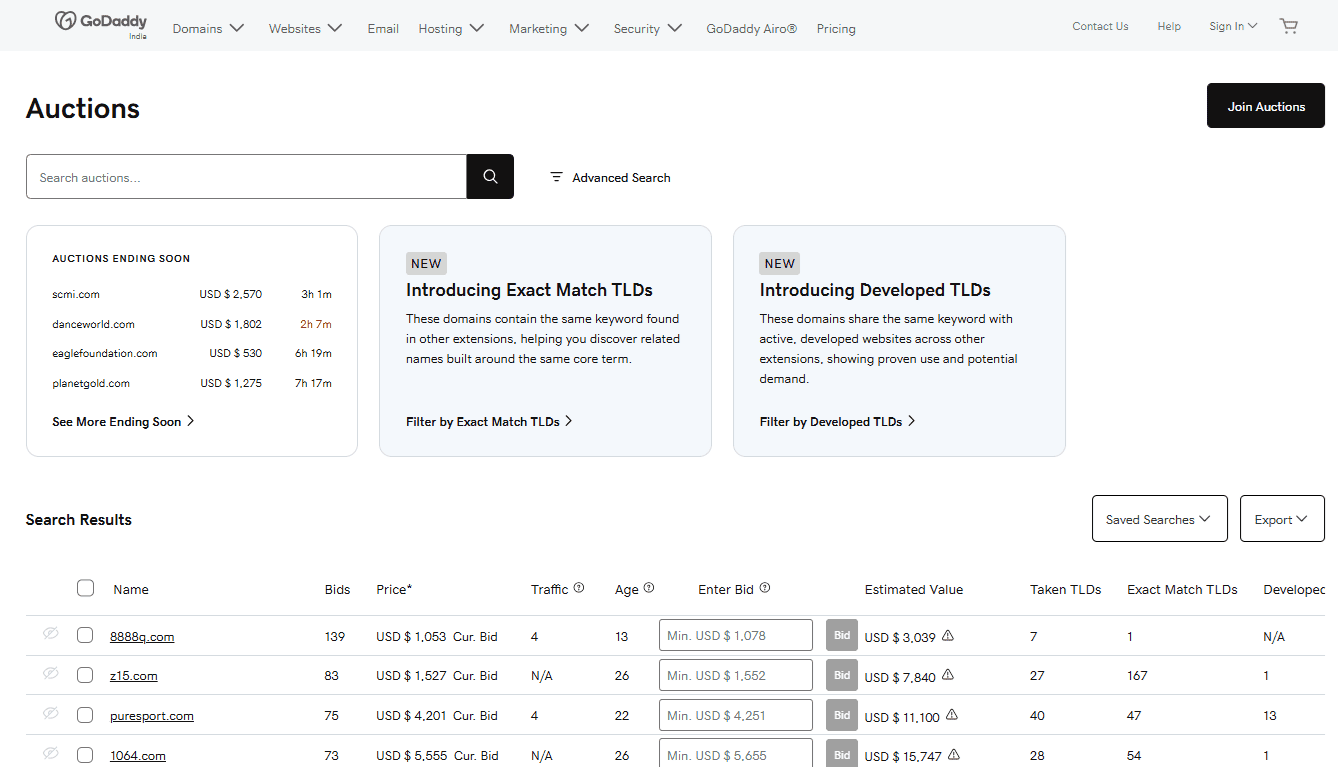
6. GoDaddy Auctions
GoDaddy Auctions
Best For: Finding high-value, high-authority domains before they hit the open market.
Price: Membership fee is $4.99/year
As the world’s largest domain registrar, GoDaddy has access to an incredible amount of inventory that never makes it to the open market.
GoDaddy Auctions is the primary marketplace where these dropping domains are sold. If a domain was originally registered through GoDaddy and the owner forgets to pay the renewal fee, it ends up here before it is fully deleted.
Features:
- Exclusive Inventory: Because so many people use GoDaddy, you can find high-value domains here that aren’t listed on other platforms.
- Expired Closeouts: After the initial auction ends, unsold domains move to a “Closeout” section where the price drops every day, eventually reaching as low as $5.
- Proxy Bidding: You can set a maximum bid, and the system will automatically increase your bid by the minimum increment to keep you in the lead until your limit is hit.
- Advanced Search Filters: You can search by keyword, domain age, and even specific extensions, though the filtering isn’t as deep as specialized SEO tools.
Pros:
- Direct Transfer: Since GoDaddy already holds the domain, the transfer process to your account is usually smoother and more reliable than catching a domain from a third-party registrar.
- High-Authority Gems: This is where you’ll find some of the best one-word or legacy domains with 15+ years of history.
- Bargain Potential: The Closeout section is a goldmine for finding decent domains for cheap price plus renewal fees.
Cons:
- Membership Fee: You must pay an annual membership fee (usually around $5) to participate in the auctions.
- High Competition: Everyone knows about GoDaddy…you, your friends, your neighbor, and even the famous baby monkey, Punch. On popular domains, you will face intense bidding wars in the final minutes.
- Renewal Costs: Even if you win a domain for $10, you are still responsible for the standard GoDaddy renewal fee, which can be higher than that of other registrars.
- Confusing Timeline: The expiration process is complex, to say the least. Even if you win, the original owner has a short window to reclaim the domain. It may result in your order being canceled and refunded.
Is GoDaddy Auctions Worth it?
This is the best marketplace for premium domains. It isn’t strictly an analysis tool, but it is the most important source of inventory in the world. If you want a domain that has been sitting on a reputable registrar for a decade, this is where you go to find it. You can also read our GoDaddy Auctions review to see if it’s worth your time.
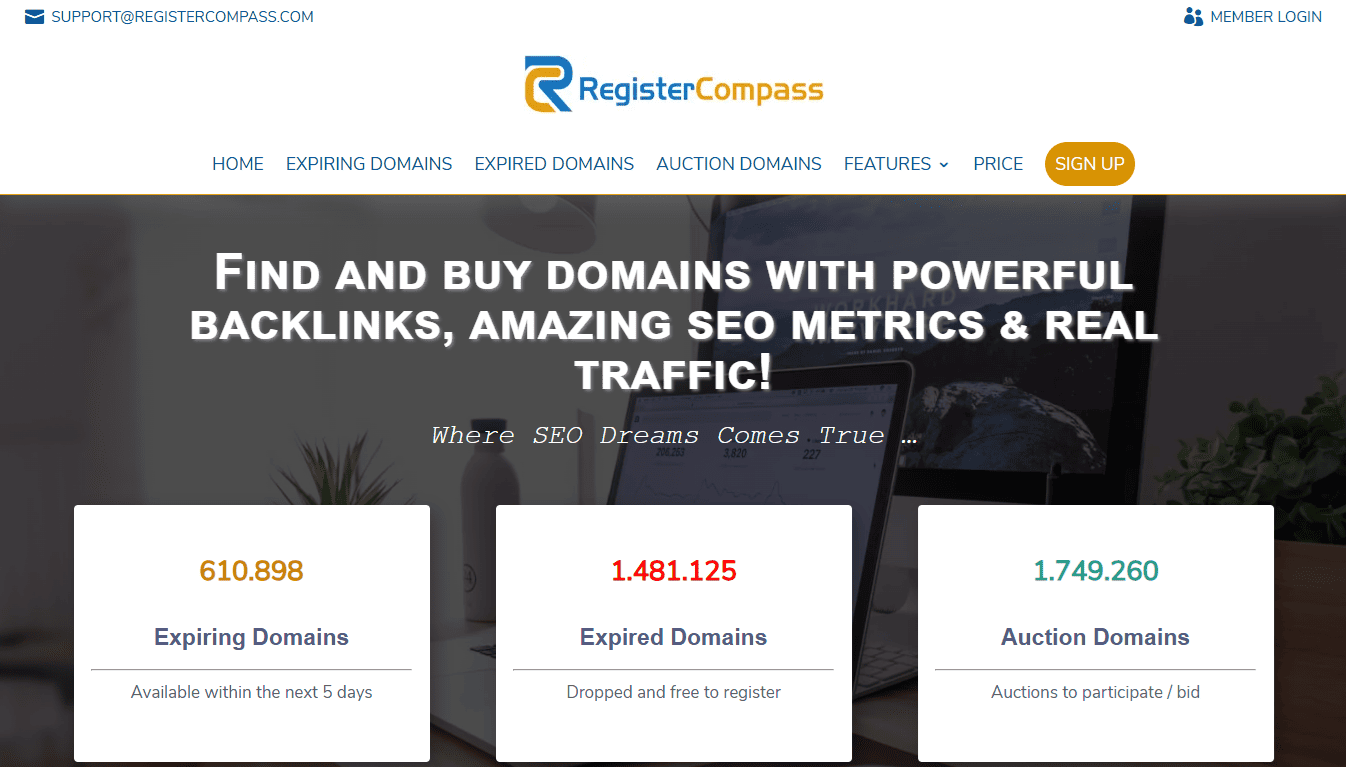
7. Register Compass
Register Compass
Best For: Power users who need deep integration with multiple auction platforms.
Price: $37/month | Quarterly: $97/quarter | Yearly: $347/year | Lifetime: $999 one-time
Register Compass is a heavy-duty tool that has been a staple in the domaining community for years. It is designed for investors who want to monitor every major auction house and “drop” list from a single dashboard.
While its interface may look like it belongs in the early 2000s, the depth of its database (covering millions of expired and auction domains) is hard to match.
Features:
- Multi-Marketplace Monitoring: It aggregates listings from GoDaddy, NameJet, SnapNames, and more, so you don’t have to check each site individually.
- Deep SEO Integration: The tool pulls live data from Majestic (Trust Flow/Citation Flow), Moz (Domain Authority), and SEMrush to help you judge a domain’s ranking potential.
- Auction & Deleted Filters: You can specifically target domains that are “Pending Delete” (about to be free) versus those that are currently in a high-stakes auction.
- Domain Availability Checker: It includes a bulk tool to check whether the names you’ve found are available to register or have already been sniped.
Pros:
- Comprehensive Search: It offers a “Power Search” feature that lets you combine dozens of filters, like domain age, character length, and keyword placement.
- Saves Time: By consolidating auction data and SEO metrics into a single table, it eliminates the need to jump between 5 different websites.
- Frequent Updates: The database refreshes constantly, which is vital for catching domains as soon as they are released.
Cons:
- Outdated UI: It’s very clunky and not user-friendly for beginners. It looks more like a technical database than a modern expired domain tool.
- No Free Trial: There is no way to test the full power of the search engine without paying for a subscription first.
- Strictly Paid: The monthly cost of $37 is an investment that only makes sense if you are planning to buy domains regularly.
Is Register Compass Worth it?
This expired domain tool is for serious investors. If your goal is to build a large portfolio or you are a professional flipper, this tool gives you a clear overview of the entire market. It focuses less on quick ideas and more on detailed data.
Buyer’s Guide: How To Choose the Right Tool
Selecting the best expired domain tool depends entirely on your goals, budget, and technical skill level. Not every user needs a high-end crawler, just as not every domain flipper can rely solely on free data. Use these three factors to help you decide:
Your Experience Level
If you are a beginner, stick to expired domain tools with a clean interface like Spamzilla or Instant Domain Search. Professional SEOs and PBN builders will get more value from DomCop’s or Domain Hunter Gatherer’s advanced metrics and custom crawlers.
The Budget
If you are just starting and have $0 to spend, ExpiredDomains.net is your only real choice. However, remember that “free” often means you have to spend more time manually checking for spam. If your time is worth more than $30–$40 a month, a paid tool like DomCop that automates the vetting process is a better investment.
Data Accuracy vs. Speed
If you need to brainstorm brand ideas quickly, use Instant Domain Search. If you need to know a domain’s exact “link juice” from sources like Majestic or Ahrefs, you need a tool like Register Compass or DomCop that integrates those specific APIs.
Conclusion
Finding a high-quality domain largely comes down to choosing the right expired domain tool for your workflow. Some platforms are great for browsing large free databases, while others focus on automated checks that help you avoid risky domains.
The goal is always the same: identify domains with a clean history, solid backlinks, and real potential. Start by defining your niche, shortlist a few promising options, and always review their history before making a decision.
If you plan to work with expired domains regularly, using a data-rich platform like DomCop can make the process more efficient by bringing multiple metrics and listings together in one place without the need to jump between tools.
Expired Domain Tools FAQs
How to buy expired domains?
The process typically follows three steps:
- Search: Use a tool like DomCop to find names.
- Verify: Check the spam history and backlink quality.
- Acquire: Depending on the status, you either register it for a standard fee (if dropped) or bid on it (if in auction) through platforms like GoDaddy Auctions.
Which is the best expired domain finder?
There is no single best tool, but DomCop is widely considered the best overall, while ExpiredDomains.net is the best for those who want free expired domain tools.
Are expired domains still good for SEO in 2026?
Yes. While Google’s algorithms have evolved to prioritize brand signals and user intent, a domain with a decade of legitimate, high-quality backlinks still provides a massive trust advantage over a brand-new domain with zero history.
What is the difference between an expired and a deleted domain?
An expired domain is still in the grace period, during which the original owner can reclaim it and is often sold at auctions. A deleted domain has been fully released by the registry and is available for anyone to register at a standard price.
Can I find free expired domain tools with high-quality metrics?
While ExpiredDomains.net offers the best free database, most high-level SEO metrics (like Trust Flow or Domain Rating) require a paid subscription to third-party services like Majestic or Ahrefs.
How do I check if an expired domain is penalized?
Use Wayback Machine to look for past black hat content. You can also check if the domain is still indexed by typing “site:domain.com” into Google to see if any pages appear.