 DomCop
If you have spent any time on DomCop filtering expired domains, you must have seen the Topical Trust Flow field sitting right next to Trust Flow and Citation Flow.
Most buyers skip past it because they do not fully understand what it measures. That is a big mistake, because Topical Trust Flow is one of the most useful filters available when you are trying to find a domain with real, relevant authority instead of just a big number that looks impressive.
So what exactly is Topical Trust Flow, and how should you use it when buying a domain? Let us break it down in super detail.
What Is Topical Trust Flow?
Topical Trust Flow, or TTF, is a metric developed by Majestic SEO. It expands on the core Trust Flow score by measuring trust relevance by topic.
Regular Trust Flow gives you one overall number between 0 and 100 that represents how trustworthy a domain’s backlink profile is in general. Topical Trust Flow takes that same concept but breaks it down by subject. It tells whether a site is trusted in particular fields such as Sports, Health, Technology, or Education.
Majestic defines it as a score between 0 – 100 that predicts how influential a URL might be based on the trustworthiness of the websites that link to it and the relevance of those websites to the topic in question.
Majestic does this across over 800 topical categories, ranging from broad ones like Business or Shopping down to specific subcategories like Reference/Education or Computers/Internet/Web Design. A domain can carry multiple TTF scores, one for every topic where it actually receives relevant links.
Take ESPN as an example. ESPN.com might score high in the Sports category but not in the Medical category, while a peer-reviewed journal will reflect the opposite. Both sites can have a healthy overall Trust Flow, but their topical strength lives in completely different places.
That distinction matters when you are buying a domain for a specific niche.
Why Topical Trust Flow Matters More Than Regular Trust Flow Alone
There is a problem with relying only on regular Trust Flow when evaluating a domain.
A high overall TF score does not tell you anything about where that trust is coming from. A domain could have a Trust Flow of 35, which looks solid on paper. However, if any of those links are scattered across gambling, adult content, and international sites, none of that trust is going to help you if you are building a health or finance website.
Majestic explains this with a simple comparison. Picture a website like eBay. It sells everything from electronics to clothing to car parts, so it naturally gets backlinks from all kinds of different sites. When you look at its topical breakdown, the trust is spread thin across dozens of categories: a bit of Shopping, Electronics, Automotive, and so on.
Now picture a site like Moz.com. Moz writes almost exclusively about SEO and web marketing, so nearly all of its backlinks come from sites within that same space. When you look at its topical breakdown, one category stands out clearly above the rest: Web Design and Development. The trust is not spread out; it is concentrated in a single, relevant lane.
That difference is exactly what you are checking for when you look at an expired domain’s TTF data. A domain with authority spread across many unrelated categories, like the eBay pattern, will not help you much if you are building a focused niche site, because none of that trust is concentrated where you need it.
On the other hand, a domain with authority concentrated in one relevant category, like the Moz pattern, is far more valuable, because that trust is already pointed in the direction your new site needs to go.
So before buying, ask yourself: does this domain’s topical breakdown look scattered across unrelated topics, or does it show a clear, concentrated spike in the category that matches your niche? You want the second pattern.
How Topical Trust Flow Is Calculated
You do not need to understand Majestic’s full algorithm to use TTF effectively, but knowing the basics helps you interpret the numbers correctly.
Majestic starts with a list of manually selected, highly trustworthy seed sites, typically major universities, government domains, and established institutions. Majestic’s algorithm assigns Topical Trust Flow scores by analyzing the link environment around these seed sites.
If a domain receives links from trusted sources within a specific topic category, its TTF score for that category rises. If it only receives links from unrelated or low-quality sources, that score stays low regardless of how many total links it has.
One thing to understand clearly: TTF scores are not percentages, and you cannot add them together to get the overall Trust Flow. Each topic category operates on its own scale because there are far fewer pages about a niche topic like tennis than there are about something broad like computers, so the 0-100 scores represent extremely different underlying volumes per topic.
This means you should never compare TTF scores across different categories directly. Only compare a domain’s TTF score in one category against other domains’ TTF scores in that same category.
How to Use Topical Trust Flow Inside DomCop
This is where the metric becomes genuinely practical for domain buyers. DomCop pulls Majestic’s TTF data directly into its filtering system, so you can search for expired domains by topic authority. Here is exactly how to do it in easy steps:
Step 1: Open the Majestic filter section in DomCop.
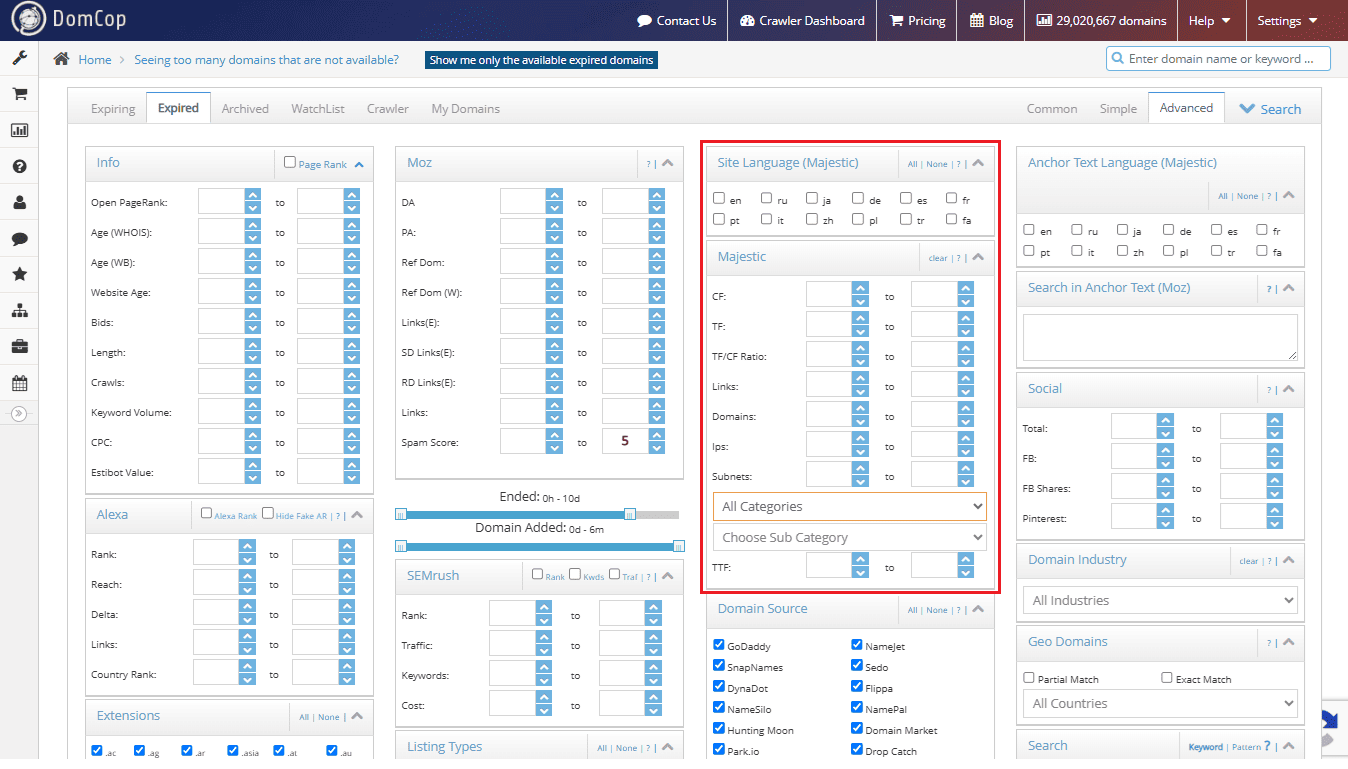
You will find dedicated fields for All Categories and Sub Categories, where Majestic categorizes domains based on their content, such as Arts, Business, or Health. This lets you find a domain that already has authority in your specific industry.
Step 2: Select your target niche category.
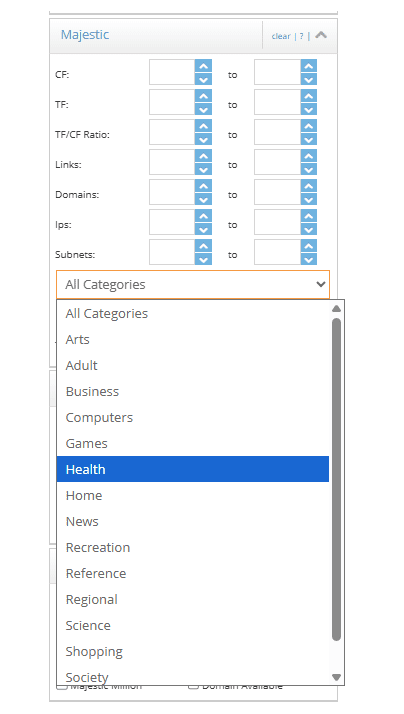
If you are buying a domain for a fitness website, select the Health or Fitness category rather than leaving this filter blank. This immediately removes domains whose authority comes from completely unrelated topics.
Step 3: Set a minimum TTF threshold.
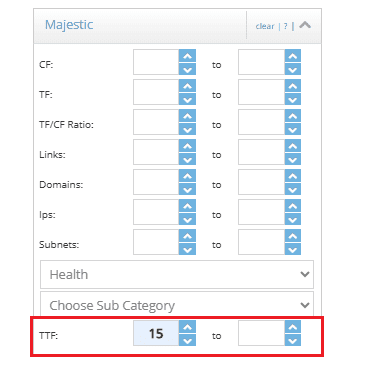
A reasonable starting point used by experienced domain buyers is to look for domains with a Topical Trust Flow greater than 15 to 20 in their target category. The exact threshold depends on your niche size, since smaller niches naturally produce lower ceiling scores.
Step 4: Pair TTF with the TF/CF ratio filter.
TTF alone does not tell you whether the rest of the link profile is clean. DomCop also lets you filter by TF/CF Ratio, a popular filter among users since a domain with high citation but low trust often signals a spammy profile. A solid approach is setting CF between 15 and 35, TF between 15 and 30, and keeping the TF/CF ratio between 0.6 and 1.2 while also requiring a strong TTF score in your chosen category.
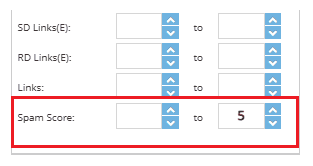
Step 5: Cross-check with the Spam Score filter.
Always run your shortlisted domains through DomCop’s Spam Score filter too. Set it to a maximum of 5%, since a strong TTF score does not automatically mean the domain is free of spam signals elsewhere.
This combo, a strong topical match plus a healthy TF/CF ratio plus a low spam score, is far more reliable than chasing a high Trust Flow number on its own.
What a Good Topical Trust Flow Score Actually Looks Like
There is no single universal number that defines a “good” TTF score, since it depends on the size of the category and competitiveness of your niche. Here are practical benchmarks based on how domain buyers commonly apply this metric:
- TTF under 10 in your target category: Weak topical signal. The domain may have general authority, but it is not meaningfully connected to your niche.
- TTF between 10 and 20: Moderate topical relevance. Worth considering if the rest of the metrics (TF/CF ratio, anchor text, spam score) are clean.
- TTF above 20: Strong topical authority. Domains with a Topical Trust Flow greater than 20 in a specific category are generally solid prospects for outreach or acquisition within that niche.
For comparison, large authoritative sites post very high topical scores. The BBC has a regular Trust Flow of 95, and Wikipedia follows closely with 94, but what matters for your purposes is not matching those numbers. It is finding a domain whose topical score in your specific category beats the average competitor you are trying to outrank.
How to Compare Topical Trust Flow Against Competitors
Here is a practical workflow you should run before finalizing any domain purchase based on TTF.
- Identify two or three competitors currently ranking well in your target niche.
- Run each competitor through Majestic’s Site Explorer or the Comparator tool.
- Note their TTF score in your specific category, not their overall Trust Flow.
- Compare those numbers against the expired domain you are considering.
Majestic’s Topics comparator allows users to compare up to ten websites at once, displaying Topical Trust Flow values for each category alongside overall Trust Flow and Citation Flow for additional context. This shows exactly where a website is most influential and where it lacks authority compared to competitors, which is far more actionable than looking at any single domain in isolation.
If your competitors are sitting at a TTF of 25 in your niche and the domain you are evaluating shows only 8, that gap suggests the domain will not bring much topical lift to your project, even if its overall Trust Flow looks fine.
Common Mistakes Buyers Make With Topical Trust Flow
Mistake 1: Ignoring TTF entirely and only filtering by overall Trust Flow.
This is the most common error. A domain with a healthy overall TF can still have zero topical relevance to your niche, which means the authority will not transfer meaningfully when you build a site or redirect the domain.
Mistake 2: Comparing TTF scores across different categories.
As covered earlier, a TTF of 20 in a niche category is not equivalent to a TTF of 20 in a massive category like Business. Always compare within the same category.
Mistake 3: Treating a high TTF as proof the domain is spam-free.
TTF measures topical relevance and trust, not the absence of spam. You still need to separately check the TF/CF ratio, spam score, and anchor text profile.
Mistake 4: Skipping the manual category selection in DomCop.
Some buyers leave the category filter on “All” because they are not sure which category their niche falls under. Take the extra two minutes to browse DomCop’s Majestic Topical Trust Flow category list and find the closest match. A vague filter setup defeats the entire purpose of using this metric.
Conclusion
Topical Trust Flow is one of the most important filters inside DomCop, and it deserves more attention than most buyers give it. It shows you topical relevance instead of raw authority, which is the real reason it works so well. Once you understand that difference, you can quickly spot a domain that genuinely fits your niche instead of one that only looks strong because of an inflated overall Trust Flow score.
Putting this into practice is simple. Select your category, set a reasonable minimum threshold, and compare the domain against your real competitors in that same category. Then pair those numbers with a TF/CF ratio check and a spam score check before you commit to anything.
This combination is what protects you from buying a domain that looks impressive on paper but delivers nothing once you actually put it to work.
Topical Trust Flow FAQs
Is Topical Trust Flow a Google ranking factor?
No. TTF is a third-party metric created by Majestic and is not used directly by Google. But it approximates topical authority, which Google does care about through its internal systems.
Can a domain have a high overall Trust Flow but a low Topical Trust Flow in my niche?
Yes, and this happens a lot. A domain can be generally trustworthy while having almost no links related to your specific industry, so it will not transfer much topical authority to your new site.
What is a reasonable minimum TTF score when filtering expired domains in DomCop?
A TTF of 15 to 20 in your target category is a reasonable starting filter for most niches, though you should always compare this against your actual competitors rather than relying on a fixed number alone.
Should I prioritize Topical Trust Flow over Domain Rating or Domain Authority?
Neither should be used alone. TTF tells you about topical relevance, while Domain Rating and Domain Authority estimate general ranking strength. Use them together, since a domain that scores well on all three is a far safer purchase.
Does Majestic publish the full list of 800+ topic categories?
Majestic does not publicly list the full topic list, though general category groupings are visible inside the Site Explorer tool and through DomCop’s own category filter list when you are searching for domains.