 DomCop
When you type “link equity” into Google, you’ll see a dozen definitions that all sound the same. The top pages usually describe it as “value passed from one page to another,” “a vote of confidence,” or “authority transfer.” All of this is true, but not very useful if you’re trying to figure out why your competitor’s page outranks yours despite having thinner content.
Link equity is the reason some pages rank with twelve backlinks while others sit buried on page three with two hundred. It’s the reason buying an expired domain with a strong backlink history can save you years of link building. And it’s the reason one sloppy redirect can quietly tank the traffic you spent years earning.
So let’s understand everything you need to know about link equity and how expired domains can save you years of work.
What is link equity, exactly?
Link equity is the value or authority that one page passes to another through a link. People also call it link juice, link authority, SEO juice, or Google juice. All point to the same thing: when a page links to yours, it shares a portion of its own trust and ranking power with you.
Think of it like a referral. A recommendation from a well-known, respected colleague carries weight. One from a stranger off the street doesn’t help you much. Search engines treat links the same way.
This concept comes from PageRank, the algorithm Google’s founders built the company on back in 1998. PageRank scored pages based on the quantity and quality of links pointing to them, on the assumption that pages earning more high-quality links were probably more useful. Link equity is the modern, practical way of describing how that PageRank value moves around the web today.
But it’s important to know that link equity and PageRank aren’t the same thing. PageRank is the score, even if Google no longer shows it publicly. Link equity is the process, the transfer of value that produces that score.
Why should you care about link equity?
Because it directly affects whether your content shows up on page one or gets lost on page seven.
A page with strong link equity tells Google two things: other sites trust this content enough to link to it, and the topic is worth ranking for.
Pages with healthy link equity also tend to get crawled more often, attract more organic backlinks over time, and help search engines understand what your site is an expert on. That last part, often called topical authority, matters even with AI Overviews becoming part of everyday search.
A 2024 study found that pages cited in Google’s AI Overviews match the top 10 organic results 99.5 percent of the time. Link equity hasn’t become less important in an AI-driven search world. If anything, it’s become the entry ticket to the top.
How does link equity actually flow through links?
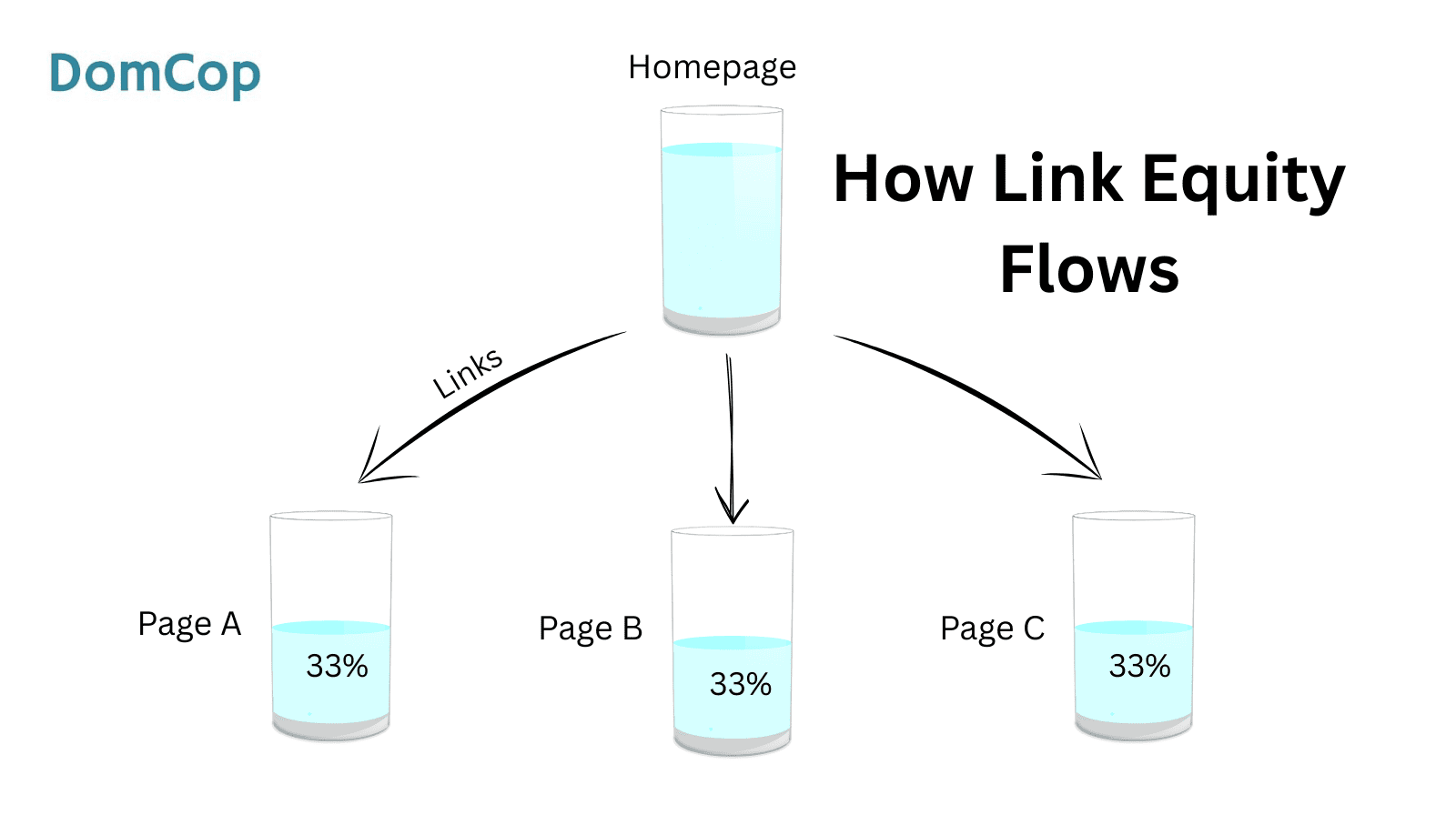
Picture a page as a jug of water. Every link on that page pours out a portion of what it holds. The more links on the page, the smaller each pour becomes. A page with 3 outgoing links gives much more to each destination than a page with 300.
Now, there are several factors that determine how much equity flows through any given link:
The authority of the linking page
A page with strong rankings and a healthy backlink profile has more equity to share than a brand-new page with no inbound links. This is usually estimated using metrics like Domain Authority (Moz), Domain Rating (Ahrefs), or Trust Flow (Majestic). None of these come directly from Google, but they’re useful enough to gauge how much weight a link is likely to carry.
Relevance between the two pages
A link from a cooking blog to a recipe page passes more meaningful equity than a link from that same blog to a page about car insurance. Google has gotten increasingly good at understanding topical context, so links from relevant sources carry more SEO value.
Where the link sits on the page
Links placed naturally within the main content of a page usually pass more SEO value than links in the footer, sidebar, or navigation menu. That’s because search engines see in-content links as a stronger recommendation from the author, while links in menus and footers are often added for navigation and appear on every page.
The anchor text used
Anchor text (the clickable words in a hyperlink) gives search engines context about the destination page. For example, “Best running shoes for flat feet” tells Google a lot more than a generic “click here.” Relevant and descriptive anchor text strengthens the equity being passed, while vague anchors waste the opportunity.
Whether the link can be crawled
A link only passes equity if search engines can find and follow it. Links hidden behind JavaScript that doesn’t render properly, blocked by robots.txt, or buried behind a login simply don’t count, no matter how authoritative the linking page is.
Follow versus nofollow
Links carrying a rel=“nofollow,” rel=“sponsored,” or rel=“ugc” attribute were historically blocked from passing equity at all. That’s changed somewhat. Since 2019, Google treats nofollow as a hint rather than a strict directive, meaning a small amount of equity may occasionally pass through, particularly in editorial content. Dofollow links remain the stronger choice if equity transfer is your goal.
Does a 302 redirect pass link equity the same way PageRank does?
This is one of the most common questions about link equity, and the answer surprises a lot of people, including SEOs who learned the “old rules” years ago.
For a long time, the accepted wisdom was that 301 redirects (permanent moves) passed full link equity, while 302 redirects (temporary moves) passed little or none. But that assumption is outdated.
Back in 2016, Google’s Gary Illyes confirmed that 30x redirects, including 301s, 302s, 307s, and 308s, all pass full PageRank to their destination. John Mueller, Google’s Senior Webmaster Trends Analyst and Search Relations team lead, later reinforced this, saying it doesn’t matter which redirect type you use for passing PageRank, as long as you use the correct one.
So why do people still use 301s for permanent changes? Because the redirect type is really about signaling intent, and not how much value transfers. A 301 tells Google the page has permanently moved, and a 302 tells Google the move is temporary and the original URL should stay indexed.
Use a 302 for something actually permanent, and Google may keep showing the old URL in search results longer than you’d like, even though equity passes through fine.
Internal links versus external links: which matters more?
Both internal and external links pass SEO value, but they serve different purposes.
External links (links from other websites to yours) are usually more powerful because they act as a vote of confidence from another site. When another website chooses to link to your content, search engines see that as a sign that your page is trustworthy and useful.
Internal links (links between pages on your own website) give you control over where that SEO value goes. You can decide which pages to link to, what anchor text to use, and which pages deserve more visibility.
This is important because the pages that attract the most backlinks, such as blog posts, aren’t always the pages you want to rank the most. By linking from those popular pages to key product or service pages, you can pass some of that SEO value where it matters most.
How redirects, canonicals, and site structure affect link equity
Technical SEO decisions have a bigger impact on link equity than most people realize, especially during site changes.
Canonical tags prevent equity from splitting across duplicate or near-duplicate pages, such as URLs created by parameters or print-friendly versions. Pointing a canonical tag at the version you want to rank consolidates scattered authority onto one URL.
Redirect chains waste equity quietly. Every extra hop, URL A to URL B to URL C, adds delay and risk. Redirect directly from the old URL to the final destination.
Site migrations are where link equity gets lost most often. Switching domains or restructuring URLs without mapping every old URL to its correct new destination causes years of accumulated equity to evaporate. A careful migration plan protects that authority instead of throwing it away.
How buying an expired domain taps into existing link equity
Here’s where link equity gets genuinely interesting for anyone building a website from scratch, rather than just maintaining an existing one.
Building backlink-based authority the traditional way, through content creation, outreach, and time, can take years. An expired domain with a clean backlink profile skips that wait. When a domain that once held real authority expires and gets re-registered, the link equity tied to its still-active backlinks doesn’t disappear. The new owner inherits it.
This only works if the domain’s link equity is real and clean. A domain riddled with spammy, manipulative backlinks carries risk instead of value, and could drag a Google penalty along with it. Serious domain buyers dig into the backlink history using tools that combine metrics like Moz DA, Majestic Trust Flow and Citation Flow, and Ahrefs DR, then manually review the Wayback Machine to confirm the domain’s past content was legitimate.
Once a domain passes that vetting, there are two main ways to use its existing link equity.
- Rebuild a site directly on the domain, restoring content close to what previously earned those backlinks.
- 301 redirect the expired domain to a site you already own, consolidating its accumulated equity onto your current authority.
If you’re confused between the two, you can read our complete guide on Rebuild vs Redirect Expired Domains.
Common mistakes that waste link equity
A few common mistakes can stop link equity from flowing effectively around your site.
Pages with no internal links out: If a page receives links but doesn’t link to any other relevant pages, the SEO value tends to stop there. This often happens with contact pages, thank-you pages, and standalone landing pages. Adding links to related content can help keep equity moving through your site.
Using nofollow on internal links: Some website owners add nofollow tags to internal links in an attempt to push more authority to certain pages. This strategy no longer works and can actually prevent SEO value from reaching pages that need it.
Keyword cannibalization: When multiple pages target the same keyword, they end up competing with each other in search results. It’s usually better to combine similar content into one stronger page or give each page a different keyword focus.
Redirect chains and poor link placement: Links that pass through several redirects can be less efficient for both users and search engines. Likewise, links placed naturally within the main content of a page often carry more weight than links hidden in sidebars or footers.
Conclusion
Link equity isn’t some abstract SEO buzzword but a mechanism that decides which pages search engines trust enough to rank. Every link on the internet, internal or external, follow or nofollow, well-placed or buried in a footer, either passes that trust along or wastes it.
Once you start seeing your site through that lens, a lot of SEO decisions get simpler. Where you place a link and how well you redirect a page matter a lot. Whether you’re starting a new project from a blank domain or with an expired domain that has years of earned authority already, the goal remains the same. You want the authority your site has earned to reach the pages that matter most.
When link equity flows efficiently, every backlink and internal link can contribute more to your rankings, visibility, and long-term organic growth.
Link Equity FAQs
What is the difference between link equity and link juice?
They both mean the same thing. Link juice is just the informal, older term for it, while link equity is the more technical term used in SEO today.
Does a page lose link equity when it links out to other sites?
No. The page keeps its own authority, but the equity gets divided among all the pages it links to, so more outgoing links mean each destination gets a smaller share.
Is link equity still relevant with Google’s AI search updates?
Yes. A 2024 study found that 99.5 percent of pages featured in Google’s AI Overviews come from sites already ranking in the top 10, and strong link equity is what gets pages there.
What is Moz link equity, and how does it measure link authority?
Moz uses its own proxy metrics, Domain Authority (DA) and Page Authority (PA), to estimate link equity on a 0 to 100 scale. They’re useful benchmarks, but not a direct reflection of Google’s internal authority signals.
Can you transfer link equity from an expired domain to your main site?
Yes, with a 301 redirect. Any active backlinks pointing to the expired domain will pass their equity to your site, which is exactly why buying expired domains is a popular shortcut for building authority fast.